
In 2011, while living in Southern California, I had just left Stonefire Grill along Brookhurst in Fountain Valley, CA. I was carrying my oldest daughter, who had been born just a few months earlier. As we were walking out, we noticed Chuck Smith—known as the pastor who let the hippies into his church during the Jesus Revolution and as the longtime pastor of Calvary Chapel Costa Mesa—walking in.
Chuck Smith was dressed well, wearing a tie and sport coat, and there was a drag to his step as he walked in from the parking lot. Though I have never been part of Calvary Chapel, nor the broader movement of Calvary Chapel churches that emerged from this congregation, there was much I appreciated about it. My own journey to faith involved a sojourn through the Vineyard USA movement, which shares history, colorful characters, and similar values with the Calvary Chapel. Many of my friends, and many I looked up to in the Vineyard movement (learn more here), spoke well of Chuck Smith, and I wanted the opportunity to introduce myself as he sat a few feet from me.
At the time, there was no Jesus Revolution movie yet, reintroducing Chuck’s story to a new generation. He was simply an elderly man walking into a popular family restaurant, most likely to meet family and friends on a Sunday afternoon, as I had just done. The warmth and welcome I would have expected from Chuck are exactly what I received. They often say, “Don’t meet your heroes,” and I understand that sentiment. I have met heroes whose real selves were difficult to face. I can’t say Chuck was a hero of mine, but I was glad to find his gentle voice, firm handshake, and compassionate piercing eyes—eyes that paused and gave me the time of day—to be everything I hoped an encounter with “Papa Chuck” would be. I thanked him for his faithfulness, and I was glad to have met him. His humility and love were tangible, inspirational, and evident.
I have a lot of respect for Calvary Chapel, though there is much I would disagree with as well, both in Smith’s theology and in the way the movement has evolved over the years. Still, there is no doubt that God used Pastor Chuck Smith, the people of Calvary Chapel Costa Mesa, and hippies across the United States—not just in Southern California—to bring a renewed understanding of God’s Spirit, love, and welcome to the evangelical church in the West.
A Look At The Reproducers
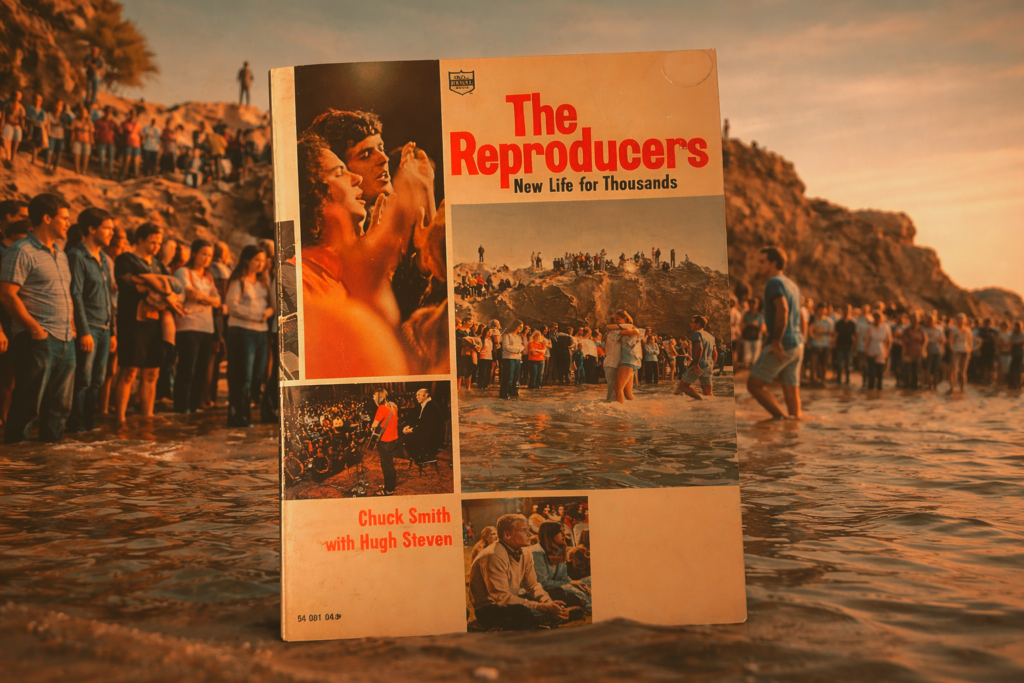
Long before there was a film by Greg Laurie, Jesus Revolution, creatively and liberally retelling the story, there was a book called The Reproducers. Written by Chuck Smith and Hugh Steven, the book tells the story of how thousands found new life throughout the 1960s and 1970s. Originally released in 1972, the book remains in print, offering a behind-the-scenes look at what happened in what was once a small country church. Last week, I pulled out my original copy of The Reproducers (Regal Books), admittedly a terrible name in today’s culture, and sat down with the story as told by Chuck Smith and Hugh Steven again. It’s been a few years since I wrestled with this lens through their own narrative, and I found myself reflecting on a lot as a pastoral leader in an era where the church has lost its identity, integrity, and intentionality.
Inside The Reproducers by Regal Books
This is a short read—about 146 pages—with wide margins and what I’d guess is a size 13 font. There are also black-and-white photos that decorate the book on occasional pages. That doesn’t mean it isn’t packed full of story, reflection, and valuable history.
I agree with Chuck in the introduction when he says, “What God has done here He desires and will do elsewhere” (Smith 1972). However, I don’t think it will look the same, or even be a continuation of what happened at Calvary Chapel, but rather something new and different. That runs against how revival has often been told to us over the years.
Smith notes that much of the book is Hugh Steven’s work, which he approves of, saying Stevens was “very accurate, and like the work itself, with all naturalness.” Hugh Steven then continues Smith’s introduction by clarifying that this is not a “how-to book.” “This book is not,” Steven writes, “a treatise on how to have a Jesus movement. It is an open-ended sharing of what God has done and is doing through Calvary Chapel” (Smith 1972). That said, there are a few places where I feel Steven detours from this posture and subtly tries to kick-start inspiration elsewhere. This is where we can slip into a dangerous copy-and-paste culture that rarely works.
The Story Broken Into Chapters
Chapter one looks at the story of Calvary Chapel before Chuck Smith and how he arrived there. This important chapter tells the story of a church that isn’t as desperate as Jesus Revolution portrays it, but rather one with struggles and cultural dominance already in place, with possibilities and prophecies as well. I love the image of a small church with a sign that reads, “CALVARY CHAPEL. JESUS CHRIST IS LORD. ADORE HIM WITH US,” becoming the place where God invites many to discover himself. The story of Chuck feeling called to this small church before Kay did, truly shows how God was already at work, quietly writing the story.
Chapter two, About Face, continues this narrative. In chapter three, Chuck introduces us to the Calvary Chapel he began pastoring and how God was breaking through even before the hippies arrived. Smith describes walking into a small community where “it just seemed that no one cared about the little church” (Smith 1972, 21). As is often the case, it is from humble beginnings that God takes messy things and writes beautiful stories. Small things become faithful witnesses to what God is doing in the world.
In chapter four, we begin to see the emergence of a new movement within the church. This chapter is full of stories—stories of people encountering the church and why they stayed. We are also introduced to Lonnie Frisbee, one of the most colorful characters of early Calvary Chapel and a shared figure in the history of the Vineyard, the movement God used to bring me back to the church. This telling feels truer and less exaggerated than later retellings like Jesus Revolution, offering a deeper look at how God brought the Frisbees into this early movement of worship and Bible study.
Chapter five continues this story, focusing on the early ministry homes Calvary Chapel started, including the infamous House of Miracles, which gives the chapter its name. Chapter six recounts some of the well-known stories, including barefoot worshipers walking on expensive carpet in “No Bare Feet Allowed.”
Chapter seven explores how the church’s tape ministry gave rise to the teaching ministry for which Calvary Chapel is known today. In many ways, in my humble opinion, this teaching emphasis perhaps beame priority and replaced some of the other manifestations they had been experiencing. Reading this story again, I am thankful for that ministry, but I also recognize this as a turning point—where a faithful, local, miracle-working, covenant community began to become a platform and a professional ministry. It is a significant shift, still used by God, but also one that has been envied, copied, and reproduced across churches in the West. In many ways, they became platform builders, and the church is still wrestling with this.
Chapter eight focuses on Maranatha and the beginnings of the worship music movement. New hymns and worship songs emerged that would define a generation. Here again, I see how something organic eventually became something others treated as DNA—copied, envied, and reproduced—giving rise to what we now call professional worship culture. Every large church movement has its own worship brand. Somewhere along the way, in the process, some of the original organic inspiration was lost as other churches were inspired by it.
By chapter nine, we reach some of my favorite sections of the book: the baptisms and the stories of people turning to Jesus and saying yes to the kingdom of God. Pirate’s Cove will always be a special place because of the thousands of baptisms that took place there. I had the chance to visit a few years ago, and it was meaningful to walk what felt like sacred ground. One of the best quotes in the book comes in this chapter from Chuck’s associate pastor, Ken Gulliksen, who would later start the Vineyard Church. He reminds us that you can’t recreate this—you can only “position yourself in the flow of God’s Spirit” (Smith 1972, 98). This is crucial. It’s not about attending Calvary Chapel; it’s about learning to reposition yourself to receive what God is doing where you are, here and now (Smith 1972, 98).
Chapter ten is where I really began to notice how what God was doing in this context became capitalized on, contributing to some of the challenges we still see in the church today. The church became a destination. The movement became a platform. Land was purchased to house growth. None of this is inherently bad. But it marked a shift that helped shape a new wave of evangelicalism—one that often missed the heart of the early days. Chuck’s integrity in stewarding money, land, and people is evident throughout this chapter, and God clearly honored it. In this sense, the chapter is inspiring for pastors around prayer, integrity, and wise spending.
Taking Inspiration From The Reproducers
At the same time, this section of the book stirred a personal challenge in me—to pray more for God’s intervention and to grow more dependent on daily bread, not just personally but as a church community. It is also here that I feel Steven again nudges readers toward imitation in subtle ways. However, that doesn’t undermine the inspiration to pray more.
The stories in the epilogue became a kairos moment for me, revealing how a church rooted in conversation and community can slowly shift toward being described in terms of being “fed” (Smith 1972, 113). These stories show how quickly something God does organically can turn into a platform and contribute to the consumeristic church culture we are still wrestling with in big-box, megachurch, and movement-based expressions today. That had its start in these early movements, full of good, but also with human brokenness. Even so, the epilogue is filled with stories of real people and real ways God moved in their lives during this season.
Recommending The Reproducers
In the end, The Reproducers is not a manual to be followed for renewal, but a witness to be listened to. It reminds us not only of the beauty of this movement and the organic beauty God brings when people are surrendered, but also warns us (unknowingly) about how we can professionally platform God’s movements. This read invites pastors, leaders, and everyday followers of Jesus to remember that renewal begins not with strategy, platforms, or imitation, but with humility, prayer, and attentiveness to the Spirit of God already at work in a particular place and people. This book reminded me that faithfulness often precedes fruitfulness, and that what God does in one moment cannot simply be repeated in another. Perhaps the enduring gift of The Reproducers is not that it tells us how revival happened then, but that it calls us back to dependence, simplicity, and trust—postures the church desperately needs again now. This is not the story of the various Jesus People groups and what God was doing with them across the globe, but it is a look at a specific group in Southern California and what God did there that inspired many people worldwide.