
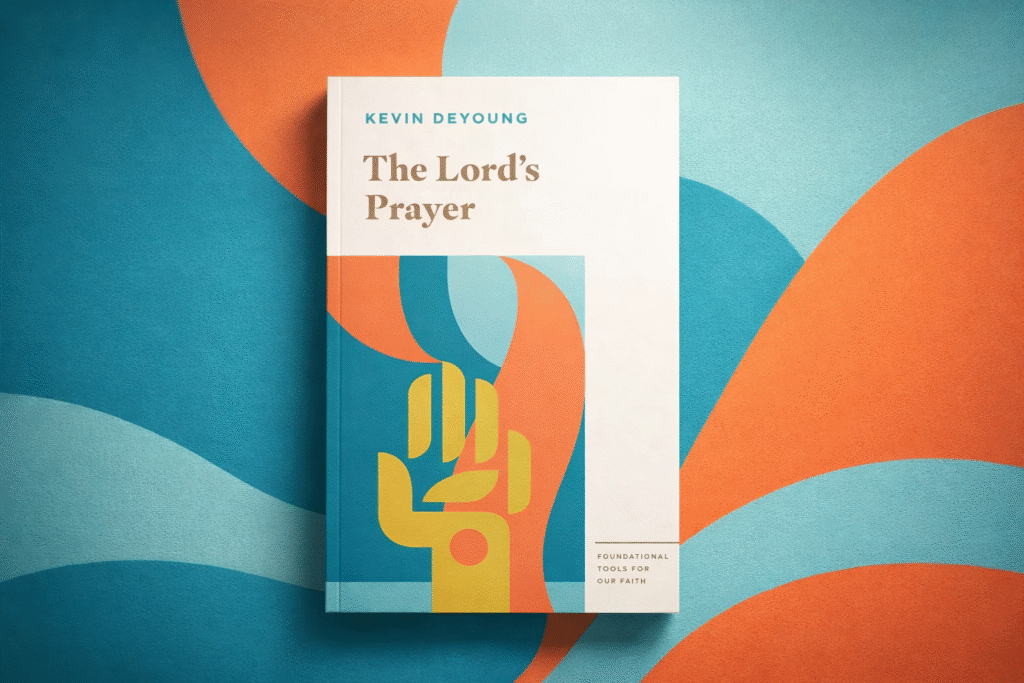
In The Lord’s Prayer by Kevin DeYoung (Crossway, 2013), part of the Foundational Tools for Our Faith series, argues that Jesus is far more concerned with what we pray than where or how long we pray (13). Rooted in the three foundational acts of Jewish spiritual discipline (almsgiving, fasting), Jesus’ teaching on prayer is presented as “a simple structure… an opening address followed by six petitions” (27). These petitions, DeYoung suggests, are the very things Jesus instructs his disciples to pray for and about (13). My own convictions echo DeYoung on where he divides and where he does not. However, he doesn’t go far into Hebrew Parallelism or Greek language systems to explain why.
The Lord’s Prayer by Kevin DeYoung: Beginning with God’s Character
DeYoung emphasizes that the primary concern of the Lord’s Prayer is an awareness of the One to whom we are praying—God’s character, authority, and holiness. To “get a better, truer, bigger, sweeter understanding of God,” he argues, the foundation for a deeper and more faithful prayer life is getting a glimpse of God more holistically (34). This opening petition, focused on God’s name, “holds all the others together” (35).
The Lord’s Prayer confronts our small personal empires and reorients both our lives and our prayer practices to be “about God’s name, not our name” (36). In that sense, the prayer is quietly radical, reshaping not just our requests but our loves. As I have explained elsewhere, it certainly is a pattern to realign our lives through confession and a framework to build our theology around.
Petitions and the Story of God
As DeYoung works through each line and petition, he does well at highlighting the layered depth of each line and petition of the prayer. While he does not fully trace every line back to its Jewish prayer roots or its early church history arguments, he consistently roots it in its Old and New Testament connections. This keeps the Lord’s Prayer grounded within the larger biblical narrative and reminds readers that this prayer belongs to the unfolding story of God rather than standing alone as a devotional formula.
The Kingdom, the Church, and a Needed Correction
DeYoung’s chapter on the kingdom is one of the strongest in the book, even if some illustrations miss the mark. I did feel that his use of Churchill’s devotion to the British Empire as an imperfect analogy for Jesus’ intent was even a distraction. However, in this chapter, he offers a much-needed corrective for the modern church by clarifying the relationship between the kingdom and the church:
“The two are not identical, but they cannot be separated… We can think of the church as a kind of outpost or embassy of the kingdom” (40).
This vision is often lost today. DeYoung also prophetically reframes how the kingdom comes:
“We cannot bring about the kingdom by elections or education or humanitarian good works… The kingdom comes when and where the King is known” (45).
Here, DeYoung is at his best, reminding readers that “the kingdom of God is not a society to be built but a gift to be received” (50). While I would add that the church is also called to embody and demonstrate the kingdom in collaboration with the King, DeYoung rightly insists that we announce the kingdom before we attempt to organize it.
Interpreting Difficult Lines Faithfully
Beyond the kingdom language, DeYoung does powerful work on themes such as daily bread, debts, and temptation. He acknowledges interpretive challenges without getting lost in speculation. I appreciated his decision—one I share—to keep “deliver us from evil” connected to “lead us not into temptation,” preserving the unity of that petition.
Structure, Accessibility, and Usefulness
At just over 120 pages, this book is concise, accessible, and theologically grounded without being heavy-handed. It is divided into seven chapters: When You Pray, Our Father, Our Desire, Our Daily Bread, Our Debts, Our Plea, and His Glory. A study guide follows, making it well-suited for group use, which is fitting for a prayer meant to be prayed with and for others.
Notes, a general index, and a Scripture index round out the volume. Among the books in this series, this is one of DeYoung’s strongest. I found it more compelling than his volume on the Nicene Creed, which felt less substantiated in places.
Theological Lens and Author Background
DeYoung’s Reformed theological framework is evident throughout, a lens I do not fully share, but it is not overtly distracting. Most readers will know his name and that his pastoral and academic credentials are well established. A native of Jenison, Michigan, DeYoung earned degrees from Hope College and Gordon-Conwell Theological Seminary, and a doctorate in Early Modern History from the University of Leicester. His scholarly focus has included the theology of John Witherspoon.
Kevin DeYoung has served as pastor at University Reformed Church and Christ Covenant Church and is a member of The Gospel Coalition Council. DeYoung is also a prolific author, with works such as Crazy Busy, Just Do Something, and The Biggest Story.
Why I Read The Lord’s Prayer by Kevin DeYoung
I read The Lord’s Prayer by Kevin DeYoung as part of my Doctor of Ministry work at Kairos University. My research explores the prayer Jesus gives in Matthew 6:9–13 as both a theological and practical framework for spiritual formation and communal discipleship. My project, The Way of Life: The Lord’s Prayer as a Path and Framework, integrates biblical scholarship, historical theology, and ministry application through curriculum development and a publishable dissertation.
For those looking for a thoughtful, accessible introduction to the Lord’s Prayer—whether for personal reflection or group study—this book is a strong, reliable starting point.
