
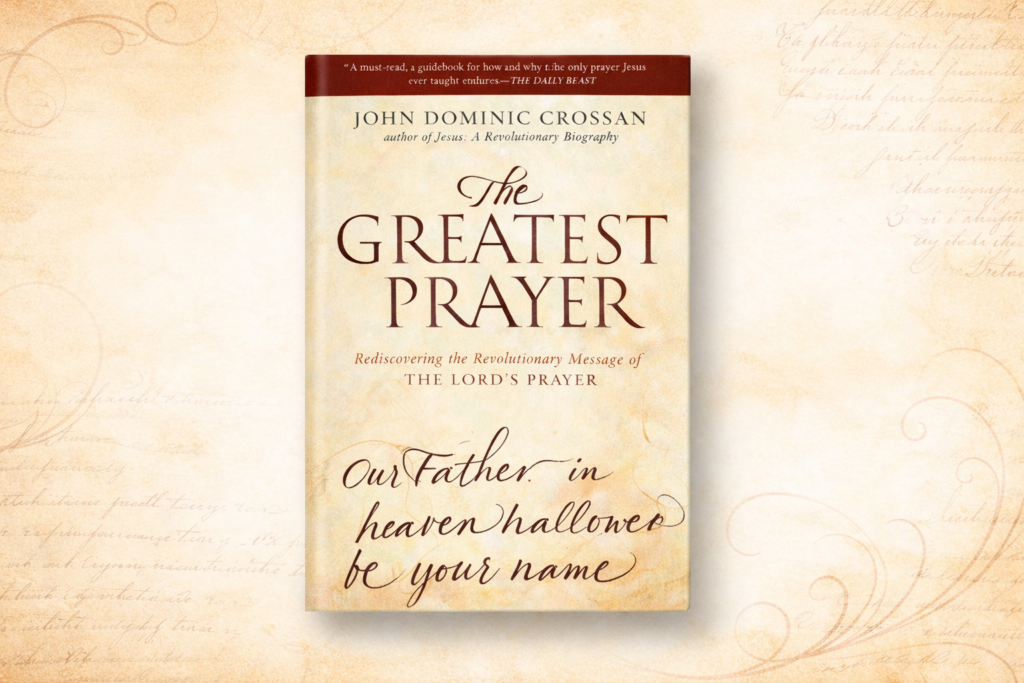
Though he is a renowned scholar, John Dominic Crossan is, at times, a contradiction—and at other times, simply difficult to explain. Crossan’s writings will shake any image of a domesticated Jesus that you may have developed or grown up with, but he will trade it for a reductionist view if you allow him. That is why when I decided to pick up The Greatest Prayer, a work presented as a revolutionary rediscovery of the Lord’s Prayer (HarperOne), I knew I was in for a wild ride. As a Doctor of Ministry student on the Lord’s Prayer, it was my hope to read scholarly and practical thoughts on the Lord’s Prayer from many different angles, including those that would fit a general orthodoxy and those less so. To explore another angle and to have any domesticated view of the Lord’s Prayer shaken free from my memory banks, I turned to Crossian’s work on the Lord’s Prayer, but there are many angles that I could not accept.
The Greatest Prayer: A Contrast
The contrast is present from the start: HarperOne, a mainstream religious publisher, paired with a provocative and perhaps even contentious scholar. Make no mistake: Crossan is highly trained and widely respected. Since the beginning, he has wanted to sway and pontificate for popular audiences. In a blog, written by him, he shares that it is at the core of his work with the highly controversial Jesus Seminar (which he helped found), “We do not want to hide our work in scholarly journals, writing only for one another. We want to let the general public know what we are doing, and invite them to join the dialogue on major issues of Jesus research.” Crossan writes primarily for popular audiences, intentionally challenging traditional theological approaches and, at times, rightly critiquing weak hermeneutics or overly simplistic social and political readings of Scripture. However, he presents his view as right, not the debate.
That said, he has also been accused—particularly by fellow Catholics—of taking nearly every opportunity “to try to debunk classical Christianity.” He may not disagree. As a founding member of the Jesus Seminar, he has argued that much of the New Testament is post-interpolation or added. He wants to find Jesus seperate of what he believed the church did “to him.” Jesus is a post-apocalyptic small-town revolutionary who gets a lot of things assigned to him by the church. Despite this, there are moments when Crossan is strikingly orthodox, especially in his unpacking of the subversive inbreaking of God’s kingdom and Jesus’ parables. In those moments, he demands to be read carefully and taken seriously. At other times, however, he seems to challenge traditional understandings simply for the sake of challenging them, reading Scripture almost exclusively through a political lens rather than a convictional one, and in doing so, missing the larger theological plot.
I have not examined much of Crossan’s work beyond The Greatest Prayer, but I have ventured far enough into his broader corpus to sense that many of the tensions I wrestled with in this book are characteristic of his work more generally. Again, I knew what I was getting into with the Lord’s Prayer, and want you to understand the lens of Crossan if you pick up his writings.
A Look at The Greatest Prayer
Published in 2010, The Greatest Prayer includes a prologue, eight chapters, an epilogue, an appendix, extensive notes, suggestions for further reading, and a discussion guide. It is a substantial and thoughtfully constructed volume, inviting readers not only to reconsider the Lord’s Prayer but also to wrestle with the theological and political claims Crossan believes it makes upon the world. For someone who has redefined his view of Jesus, I find it ironic that Crossan still holds a high regard for the Lord’s Prayer and its almost revolutionary manifesto-like nature.
As I read Crossan, I found myself both helped and frustrated. He is right to insist that the Lord’s Prayer is strange, public, and formative rather than private and sentimental, and I agree with his opening claim that it is Christianity’s greatest and strangest prayer. It is prayed everywhere, yet it names neither Christ nor church nor ritual, which should already slow us down. At the same time, I do not follow him in every interpretive move he makes, especially when the justice lens becomes so dominant that other dimensions of the prayer feel muted or distorted. Justice is present, but so are forgiveness and dependence, as well as theological and value realignment. Still, his insistence that this prayer resists being reduced to personal devotion alone is a needed corrective; it stops a domesticated view of Jesus, and this prayer, and his overall framing, help us understand some first-century worldviews, and it also exposes how often we emphasize what the prayer never says while ignoring what it actually trains us to seek.
Inside The Greatest Prayer
One of Crossan’s central claims is that the Lord’s Prayer is meant for all, not just Jews or Christians, and while I agree with the instinct, I do not think he fully grounds it. Though there is hope for all found in it, its meaning cannot be separated from Jesus and what it means to belong to Jesus. I share his sense that there is no other prayer quite like this one, and that its uniqueness sets a standard for what prayer is meant to do. It is, as he says, a radical manifesto and a hymn of hope for those who pray it. I like those terms. Where I begin to diverge from Crossan is that Crossan locates (or re-locates) the center of the prayer almost entirely in distributive justice. I am persuaded instead that the prayer’s core, like the heart of Israel’s faith, is radical dependence on God, surrender, and realignment. I do believe justice is present and that justice matters deeply, but it flows from a relationship. Restoration comes not simply through justice enacted, but through lives reordered by trust, obedience, and reliance on God as Father.
Crossan’s treatment of biblical poetry is one of the book’s strongest contributions. I agree that poetic parallelism is not lazy repetition but a way of creating theological pressure that draws the reader into deeper surrender and reflective meditation. The Lord’s Prayer clearly employs this Hebrew poetic logic, with petitions that interpret and echo one another. I am less convinced by his insistence on crescendo parallelism as the dominant structure. Unlike many psalms, the prayer does not seem to build toward a final, singular climax. Still, his emphasis on parallelism is helpful. John Dominic Crossan’s teaching on parallelism is deep. Seeing how name, kingdom, and will correspond to bread, forgiveness, and deliverance encourages a slower, more integrated way of praying, one that refuses to separate heaven from earth or divine action from human responsibility. This prayer is full of both God’s responsibility, that which we pray for, and our responsibility, to yield to the work, will, way, and theology of God.
That poetic and theological framework shapes the rest of the book. In the Prologue and first chapter, Crossan establishes prayer as empowerment and collaboration rather than mere request, and his movement from petition to gratitude to participation is a compelling picture of prayer’s maturity. Chapter 2 is, in my view, the most enriching section, especially his development of Father as householder. If you read this chapter alone, it will be worth it. Crossan’s image of God as a Father, Householder, deepens the intimacy of Abba while giving it moral, missional, symbolic, and communal weight. The cloud of unknowing, he maintains, is pierced when we understand God as Father. I like this idea. God’s character is revealed by how the household is ordered, protected, and sustained. Chapter 3’s focus on “hallowed be your name” reinforces this by tying holiness to lived faithfulness, Sabbath rest, and a shared life that reflects God’s character in the world. Even where I disagree with Crossan’s emphasis, the book has pushed me to pray the Lord’s Prayer more slowly, more communally, and with a deeper awareness of the kind of life it is shaping me to live.
From Chapter 4 on, Crossan presses the implications of the prayer outward into the political, economic, and ethical realities of the world. Again, each chapter has a social-political-historical context that we cannot ignore. Crossan is a scholar in this area. However, I feel he continues to lose the full plot of the petition at hand in his view of justice. In “Your kingdom come,” he insists that the kingdom of God is not about the end of the world but the end of a violent age, and that it names God’s ruling style in contrast to empire. I find this distinction helpful, especially his emphasis on the nonviolent character of God’s kingdom and the danger of collapsing it into Rome’s logic of power. Where I am less persuaded is his tendency to downplay future hope almost entirely in favor of present collaboration. He tiptoes into Ladd’s inaugurated Kingdom, but makes it a showdown of empires rather than a marriage or relationship between Creator and Creator. Still, his core challenge stands. The kingdom does not arrive apart from human participation. God has chosen to work in, with, and through us. That means to pray this petition is to accept responsibility for living now in ways that reflect God’s reign rather than merely waiting for divine intervention later. We pray for intervention and hold out our hands, asking God where we should act on what we are praying for.
Chapter 5, “Your will be done on earth,” brings that responsibility into sharper focus. Crossan’s reading of Psalm 82 is worth considering. Injustice is not framed primarily as something God punishes from above, but as something that destabilizes creation itself. It is part of the Chaos that God is bringing under his reign and into order. The world shakes when God’s will is ignored. I find this emphasis on consequences rather than punishment clarifying, even if, at times, it feels underdeveloped theologically. Actually, there are quite a few leaps that I am not sure how he made. His connection between the Lord’s Prayer and Jesus’ prayer in Gethsemane is one of the more compelling moves in the book. It grounds the prayer not only in teaching but in Jesus’ own costly obedience. This is certainly present in the prayer. God’s will is not abstract or vague. It is lived out through faithfulness that often leads to suffering rather than around it. God calls us to pray for his deliverance and sustaining power as we are sent out into the world.
In Chapter 6, “Give us our daily bread,” Crossan is again at his best when he links prayer, economy, and table fellowship. His insistence that this petition assumes a world where there is enough if bread is shared rather than hoarded is both unsettling and faithful to the biblical witness. I appreciate his connection between manna, the feeding stories, and the Lord’s Supper. All of these are important things indexed in the prayer Jesus taught us to pray, but sadly, he loses me in the weeds again at times. Daily bread is not only about provision but about trust, limits, and shared life under God’s care. Chapter 7, on forgiveness of debts, continues this emphasis. While the New Testament clearly moves from literal debts to sins and trespasses, Crossan rightly reminds us that the metaphor only works because economic realities mattered first. I disagree: this is not about economic realities, but about how our trespasses (debts) mirror them. However, to experience God’s forgiveness does redefine how we approach our economic world. Forgiveness is not sentimental or optional. It is the necessary shape of life in God’s household, and our willingness to forgive is inseparable from our reception of God’s forgiveness.
The final petition, “Lead us not into temptation,” brings the prayer to its sharpest edge. Crossan’s argument that this temptation is not generic but specific, namely the temptation to use violence in God’s name, is persuasive in its historical context. For first-century Jews living under Roman occupation, the lure of redemptive violence was real and powerful. The prayer ends, then, not with comfort but with warning. Even holy ends cannot justify unholy means. Taken together, the second half of the prayer mirrors the first. God’s name, kingdom, and will are made visible through bread shared, debts forgiven, and violence refused. Even where I resist some of Crossan’s conclusions, I am left convinced that the Lord’s Prayer is not something we simply recite. It is something that forms us, confronts us, and commits us to a particular way of life before God and for the sake of the world.
Closing Thoughts
In the end, this is a good and worthwhile read, especially because of the strengths Crossan brings at his best. It is history, not theology. It is very much a book where you have to chew the meat and spit out the bones. My starting place and Crossan’s are different, and that difference matters. While he may enrich our view and create a less-than-domestic manifesto from this prayer, his lack of an anchor also leads to legendary missteps. Even where I disagreed, the book slowed me down and made me listen more carefully, and that alone made the reading worthwhile.