
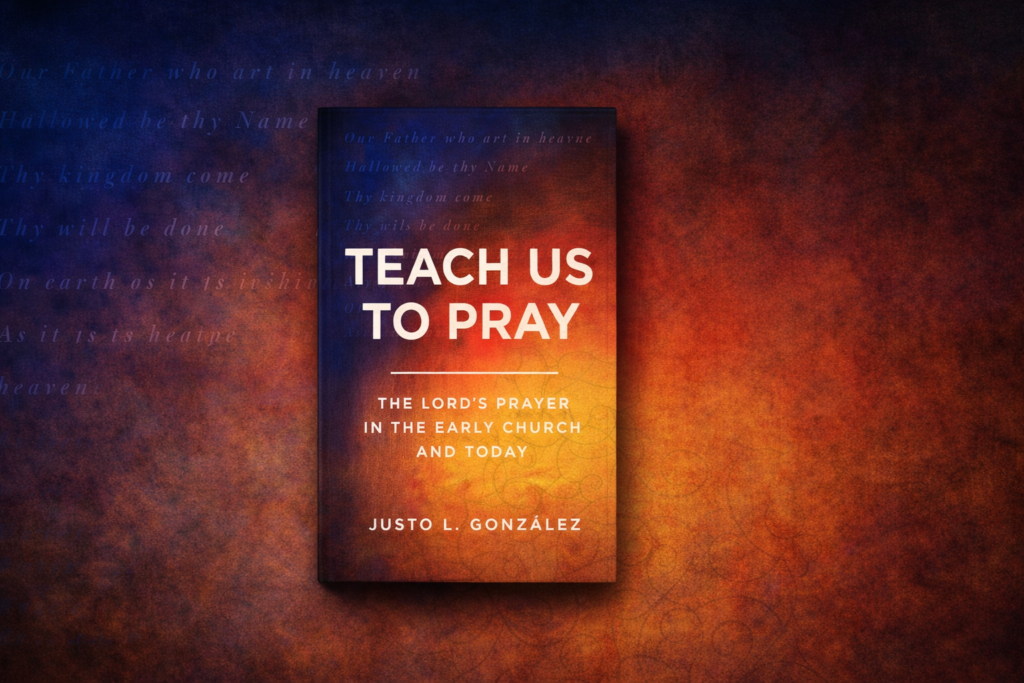
The early church held a high view of the Lord’s Prayer. It was more than a daily practice; it also kept the community spiritually connected. The prayer was used in communal settings, in the practice of the Lord’s Table, and as a tool for theological formation among disciples and those preparing for baptism. In Teach Us to Pray, Justo L. González explores the Lord’s Prayer through the lens of both the early church and the contemporary church. Released in 2020 by Eerdmans (Grand Rapids, MI), the book spans just over 180 pages and seeks “to explain how the ancient church used and understood this prayer” (González 2020, 6). A second focus of the book is formative: drawing “on the basis of what we learn from those ancient brothers and sisters,” González offers “reflections about the meaning of this prayer that the Lord taught us” (González 2020, 6). These descriptors are what caught me to read this book for my studies at Kairos University.
The Author: Justo L. González
Dr. Justo L. González was ordained as a minister in the Methodist Church in 1957. In 1961, he became the youngest person to earn a doctorate in Historical Theology from Yale University. Over the next thirty years, González taught at a range of theological institutions, beginning with eight years at the Seminario Evangélico de Puerto Rico (1961–1969). He also served on the faculties of Emory University, Columbia Theological Seminary, and other institutions.
Now 88 years old (as of 2025), this Cuban-born theologian continues to teach and write and remains a leading voice in what is often described as Hispanic theology. González has been a formative presence for generations of students and pastors through his writing. Many readers will be familiar with The Story of Christianity, first published in 1984—a work I was introduced to during my studies at Fuller Seminary.
Scope and Aim of Teach Us to Pray
The background González has is substantial, his training thoroughly academic, and his influence on modern theology well established. Teach Us to Pray, however, is less dense than many of his earlier works (185 Pages). Rather than offering an exhaustive or contested treatment of each petition, González provides a guiding lens shaped by the early church fathers, inviting readers to hear the Lord’s Prayer as it was received, practiced, and lived by the early Christian community.
Initial Impressions and Critical Concerns
Before reviewing this book, I sat with my thoughts for a while. As one reviewer on Amazon noted, “Humbly and simply, Justo explains the Lord’s Prayer. I learned so much. You will too.” I agree. Yet the lack of robustness left something missing for me. González’s approach is generally orthodox and will undoubtedly prompt readers to reflect on why we pray the Lord’s Prayer and what it offers the Church. He rightly presents it as a collective prayer—prayed both communally and individually—meant to realign us with God’s will, reign, and rule in our everyday lives and the spaces we live, work, worship, and play.
There are a few places where González departs from the dominant scholarly consensus, which can be refreshing (more to be said later). However, he is also prone to making absolute statements without fully engaging or even acknowledging opposing views, sometimes by the same church father or a societal counterpart. At times, the quotations from the early church on the Lord’s Prayer feel truncated. As a doctoral student focused on the Lord’s Prayer, I have spent time reading figures such as Tertullian, Cyprian, and Gregory, as well as later voices such as Augustine, Luther, and Calvin. What we receive here is a selective presentation that emphasizes specific lenses and themes but does not always offer a complete or balanced picture.
Wrestling with Early Church Complexity
The early church is complex, and González does not entirely shy away from that complexity. He notes where theological understanding has shifted over time, where early interpretations were insightful, and where they remain in tension with what we understand today. This is important to wrestle with, and I had to do so as I read the church fathers and found some surprising nuggets of belief and conviction about this pattern of prayer (such as the belief that the word “daily bread” was made up by the gospel writers). This makes the book challenging in constructive ways, and his angle is genuinely distinctive. Still, I found myself wishing for greater depth and care in several of his arguments.
Why This Book Fits My Research
As a Doctor of Ministry student at Kairos University, my work centers on the Lord’s Prayer in Matthew 6:9–13 as a lived pattern for discipleship rather than a formula to master. I approach the prayer as both theologically rich and practically formative, shaped by its Jewish context and its use in the early church. My doctoral project, The Way of Life, develops this framework through research, curriculum design, and applied ministry reflection.
This focus explains why I picked up Teach Us to Pray. I had already worked through the core texts required for my research. Still, because I am especially interested in how the Lord’s Prayer interacts with Jewish prayer practices, first-century Judaism, and the voices of the early church, I added this book at the end of my research phase to engage González’s perspective.
Aquinas, the Gospels, and the Didache
The book opens with a general introduction to the Lord’s Prayer and its use in the life of the church. Drawing on Thomas Aquinas, González describes the prayer not only as “a rule for our petitions,” but also as “a guide for all our sentiments” (González 2020, 5). While he acknowledges differences between Luke, Matthew, and the Didache, González does not explore them in depth. Instead, he suggests that the existence of a third version in the Didache points to the prayer’s widespread oral use in the early church, resulting in slight variations (González 2020, 7).
That explanation is possible, but it feels underdeveloped. Most scholars contextualize Luke and Matthew differently, and the Didache’s version is notably close to Matthew’s—likely dependent on Matthew’s Gospel, with liturgical adjustments such as the added benedictory line. This is one of several moments where González asserts without fully explaining or defending his position.
Baptism, Catechesis, and the Lord’s Prayer
Where González is strongest is in his treatment of the early church’s use of the Lord’s Prayer, particularly his engagement with Tertullian and On Prayer. Here, González shows how the Lord’s Prayer functioned within baptismal preparation. Those seeking baptism underwent a lengthy catechumenate, often lasting two years, during which they were taught the creed and instructed in the Lord’s Prayer. As a result, much of the early church’s reflection on the prayer emerges from the context of baptismal formation rather than abstract theology (González 2020, 15).
The Kingdom: Present Signs and Future Fulfillment
González’s treatment of the kingdom is practical, especially in how he unpacks God’s rule and reign. While he rightly emphasizes that Jesus embodies the kingdom, I am less convinced by his tendency to equate Jesus and the kingdom as one and the same. Still, I agree with his claim that we “see signs of the kingdom wherever the love and will of God are revealed,” and that even though the kingdom is a future hope, it can also be experienced in the present wherever love overcomes hatred and evil (González 2020, 85). These moments, however, are better understood as fruits of the kingdom rather than the kingdom itself. The good news of the kingdom is that God’s reign is actively breaking into the present, inaugurating a reality that has begun but is not yet complete.
“Give Us This Day Our Daily Bread”
One chapter González handles particularly well is his discussion of the petition, “Give us this day our daily bread.” While he does not lean heavily into Jewish thought here, his engagement with early church interpretations is strong—and notably divided. Some early leaders understood the bread as literal and daily; others read it eschatologically, eucharistically, or christologically. González traces this development carefully and concludes that most ancient writers eventually held all three meanings together: daily physical sustenance, Christ as spiritual nourishment in worship, and the Word that feeds believers each day (González 2020, 107). The petition ultimately asks for “the food that is needed”—a phrase that could also refer to a soldier’s daily ration—and pointedly, nothing more.
“Lead Us Not into Temptation”
The second strongest and most distinctive section of the book is Chapter 9, “Lead Us Not into Temptation.” González takes an approach few modern writers attempt. He argues that the Greek verb commonly translated “lead” genuinely carries the sense of guiding or bringing someone along the way, drawing parallels from Luke and Hebrews to support the traditional wording (González 2020, 132). Rather than reworking the phrase to avoid theological discomfort, González accepts the tension and frames the petition in light of Jesus being led by the Spirit into temptation. In this sense, the prayer becomes an honest request that God would not lead us into such testing, while trusting that when temptation does come, God provides the strength and resources to resist (González 2020, 133). Even in these difficult moments, González suggests, believers are being shaped as children of God and formed into the divine image (González 2020, 136).
Final Assessment
Through Teach Us to Pray, Justo L. González offers historical windows into why the Lord’s Prayer is both revolutionary and demanding. This is not the most exhaustive treatment of the prayer, nor does it always engage its Jewish background as fully as it might. Some conversations feel abbreviated. Even so, the book serves as a thoughtful and challenging guide, especially for readers who want to wrestle with the Lord’s Prayer in its theological, historical, and practical dimensions.