
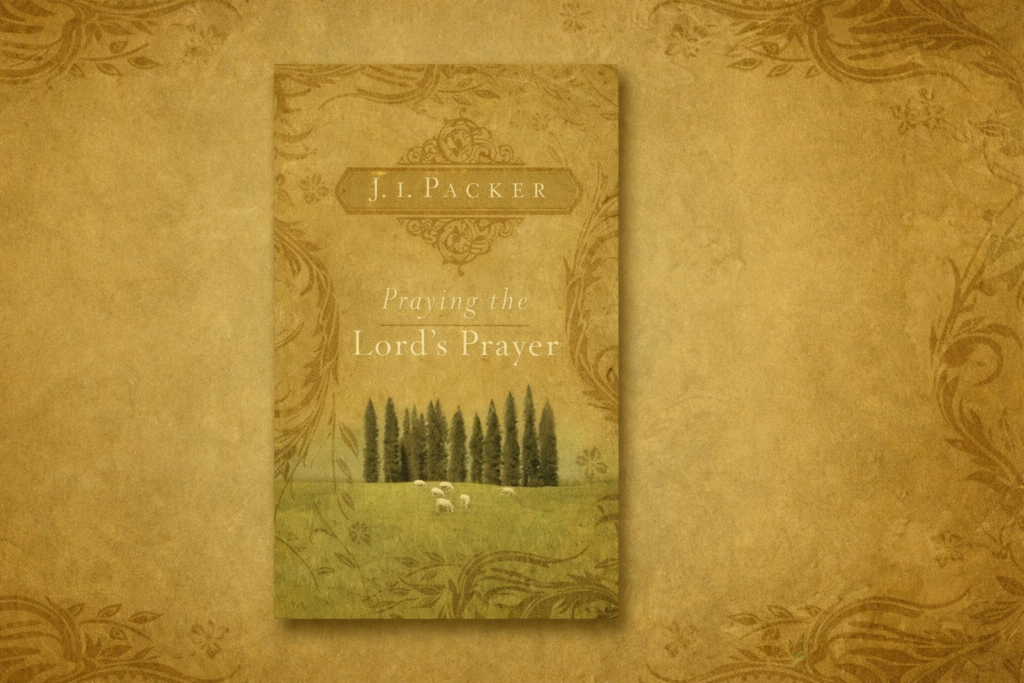
Released in 2007 by Crossway, J.I. Packer’s Praying the Lord’s Prayer looks at the Lord’s Prayer as being “full of meaning,” arguing that it is a “compendium of the gospel…a body of divinity…a rule of purpose as well as of petition, and thus a key to the whole business of living” (Packer 2007, 11). I agree with Packer that the list of petitions we receive in the Lord’s Prayer teaches us “what it means to be a Christian,” and that such a list “is nowhere clearer than here” (Packer 2007, 11).
This is the Lord’s Prayer in a nutshell. It not only provides a pattern for confession and a card catalog that summarizes all of Jesus’ teaching, but it is a framework to build our theology and priorities around. No clearer, more oral, or more memorable passage reminds us, teaches us, and realigns us with true Christianity than this prayer.
Context and Purpose of Reading of Praying the Lord’s Prayer
I read Praying the Lord’s Prayer by J.I. Packer as part of my Doctor of Ministry work at Kairos University (learn more about me). In reading over 10,000 pages on the Lord’s Prayer, I have explored it theologically, ideologically, historically, and practically. Though Packer is no slouch theologically, this book is not one of his deeper theological explorations. Instead, this book is a practical look at a rich prayer and a call to a more evolved prayer life.
About the Author of Praying the Lord’s Prayer
Perhaps best known for his book Knowing God (1973), James Innell Packer (J.I. Packer) was born in Twyning, England, and died in Vancouver, British Columbia. Packer spent his life in the Anglican and Calvinist traditions. While I do not share all of those convictions, I have appreciated much of Packer’s ecumenical work. Sadly, we lost Packer in 2020 at the age of 93.
Packer was deeply influenced by the lectures of C.S. Lewis, which he heard in person, and he also studied under Martyn Lloyd-Jones for a year. These experiences, along with a clear sense of calling, led him to become a prolific theological influence within evangelicalism. At the time of the publication of Praying the Lord’s Prayer, Packer was Professor of Theology at Regent College in Vancouver, British Columbia. He wrote numerous books, contributed to various ecumenical statements, and played a role in the English Standard Version (ESV), an evangelical translation based upon the Revised Standard Version of the Bible, widely used in Reformed and Calvinistic contexts.
Strengths and Limitations of the Book
This practical look at the Lord’s Prayer reminds readers of its revolutionary and radical nature. It does not, admittedly, engage much with theology, history, or shared connections to other Jewish prayers. Though the book is ecumenical in nature, readers will still encounter some of Packer’s Calvinistic leanings.
This is perhaps most evident in the Preface, where Packer suggests that the “venerable formulae” which together “add up to Christianity” are the Apostles’ Creed, the Ten Commandments, and the Lord’s Prayer. In doing so, he ignores the Beatitudes, which function very much as the new Ten Commandments for the ecclesia that Jesus institutes. While I agree with Packer that there is no clearer place than the Lord’s Prayer to sum up Christianity, I struggle to see the Apostles’ Creed as more instrumental than the red-letter teachings of Jesus.
Packer also argues that not all people are God’s children by nature, yet he does not sufficiently theologically substantiate this claim in light of the Lord’s Prayer itself (Packer 2007, 27). I do not necessarily disagree with his conclusion, but I am uneasy with unsubstantiated theological assertions.
Another challenging moment comes in Chapter 8, when Packer addresses the line “on earth as it is in heaven.” He argues that only “three doctrinal statements bind the Lord’s Prayer together.” For him, the first two are the innovations of God as Father and God as being in heaven. The third is that God’s will is done in heaven. In doing so, Packer underplays the inaugurated kingdom as a theological statement. He also minimizes the theological weight of daily dependence on Jesus through daily bread, the relational cost of forgiveness, and the conviction that deliverance can only come from God. These are all theological doctrinal statements that not only bind the prayer together, but the Christian looking to live faithfully.
While Packer affirms the importance of the order within the prayer, he ultimately centers its theology on God as Father (of Christians alone), God’s heavenly location, and God’s heavenly will. Yet the prayer functions as a complete framework for theology and practice. It is as much about God’s kingdom breaking in here and now—transforming lives and communities—as it is about eschatological hope. Despite these frustrations for me, Packer offers a practical and accessible guide, complete with Scripture references and questions for reflection and discussion at the end of each section. I will revisit this book again.
Structure and Style
Praying the Lord’s Prayer is a small, devotional-sized book. At 120 pages, it contains no study guide or deep dives. Each chapter is short, and for such a brief volume, there are many chapters—sixteen in total. One of the strongest features of the book is Packer’s practice of summarizing, in his own words, what we are actually praying in each line of the prayer.
Let me share an example of his dynamic summarizing (ironic for a literal guy). In the chapter “Thy Kingdom Come,” Packer writes:
“To pray ‘thy kingdom come’ is searching and demanding, for one must be ready to add, ‘and start with me; make me your fully obedient subject. Show me my place among ‘workers for the kingdom of God’ (Colossians 4:11), and use me, so far as may be, to extend the kingdom and so be your means of answering my prayer” (Packer 2007, 53).
I not only agree with the intent of what Packer says is being prayed here, but I also appreciate how he explains it.
The Petition for Daily Bread
One of the strongest chapters, and one of my personal favorites, is Chapter 9, which deals with the petition for daily bread. Here, Packer is both practical and theological. Packer explains that those who “truly pray the first three petitions thereby commit themselves to live wholly for God, and the natural and logical next request is for food to give them energy for this” (Packer 2007, 71). That is a theological assumption that calls for good reflection.
At the same time, this petition reminds us that “we do in fact depend every moment on our Father-Creator to keep us and the rest of the universe in being” (Packer 2007, 71). This dependence should cultivate humility and worship:
“Petitions looking to God as the sole and omnicompetent source of supply of all human needs, down to the most mundane, are expressing truth, and as the denying of our own self-sufficiency humbles us, so the acknowledging of our dependence honors God” (Packer 2007, 72).
Packer connects this petition to the manna narratives in the Old Testament, the feeding of the 4,000 and 5,000, and Jesus’ broader teaching ministry. We are reminded that “God cares about physical needs no less than spiritual; to him, the basic category is that of human needs, comprising both” (Packer 2007, 72). This is a reminder too of his goodness as our Father.
For Packer, this petition is never selfish or individualistic. The prayer for “our” daily bread is inherently intercessory. “Bread” encompasses all food, and therefore the prayer extends to farmers and famine relief. It also includes clothing, shelter, physical health, social services, medical care, employment, and economic justice. As Packer writes, this petition becomes “a cry against poverty, unemployment, and national policies that produce or prolong both” (Packer 2007, 74). This line of the prayer presses us toward deeper dependence on God, greater humility, greater worship, and a more active concern for the needs of others.
Prayer, Transformation, and Vision of God
Packer helps readers see that the Lord’s Prayer calls us to “examine [ourselves] and let others examine them for the detecting of day-to-day shortcomings” (Packer 2007, 79). He also challenges the shallow, routine approaches many Christians take to prayer, suggesting that such approaches help explain why prayer so often feels dull and untransformative.
One of the book’s most memorable lines captures this well: “The vitality of prayer lies largely in the vision of God that prompts it. Drab thoughts of God make prayer dull” (Packer 2007, 35). This quote will stay with me.
By learning the meaning of each petition, by recognizing the prayer as both confession and framework, and by seeing it as a concise summary of what it means to be a Christian, the Lord’s Prayer realigns our lives around true kingdom priorities. When understood and prayed rightly, it invites us into a prayer that is anything but dull.