
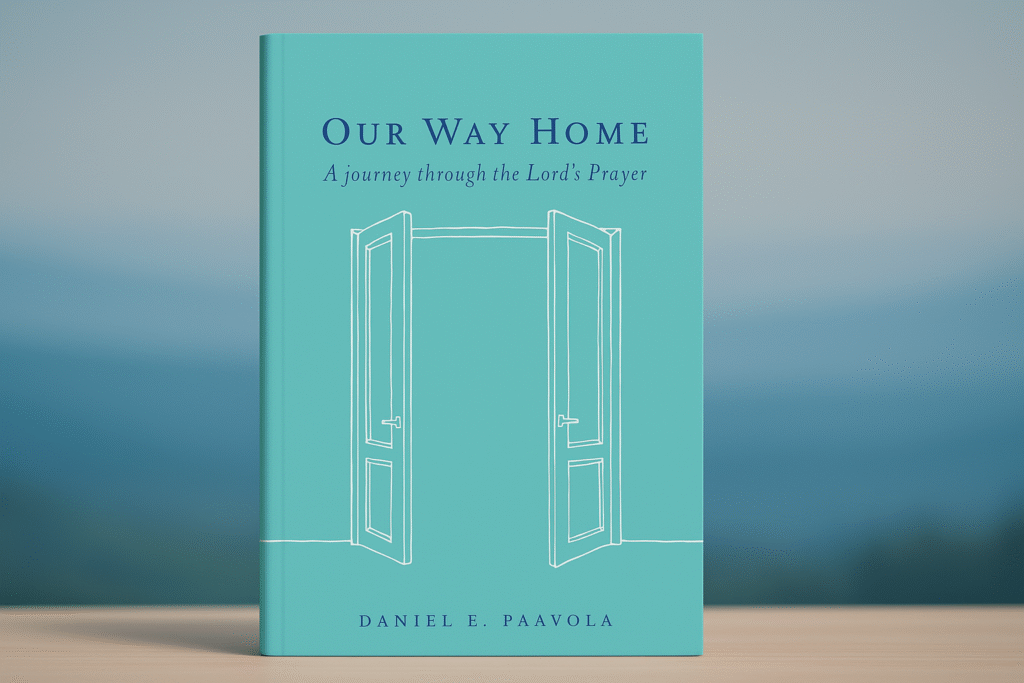
In Our Way Home: A Journey Through the Lord’s Prayer, Daniel E. Paavola describes the prayer as “an adventurous trip with God, following the path laid out by Jesus in the prayer” (Paavola 2017, 18). This is helpful imagery, and it is one he will keep (alongside other symbolic images) throughout the book. Published in 2017 by Concordia Publishing House, the book presents the Lord’s Prayer as both a destination and a journey: an act of prayer that leads us home to the Father. It was an interesting and intriguing approach to the framework found in the Lord’s Prayer.
Paavola writes:
“The Lord’s Prayer shows us heaven as our Father’s home. He has brought us to His home in His Son, and our prayer reminds us that our Father hears us in heaven. Our Father’s home is our solace when we’re battered. We pray as tired children who need the reassurance that our voices are already heard in heaven” (Paavola 2017, 12).
For Paavola, praying the Lord’s Prayer is not rote repetition, but an encounter with God’s presence —an important reminder from the start, through to the end, that we are welcomed as children into the Father’s house.
The Structure of the Journey
Central to Paavola’s treatment is the idea that the Lord’s Prayer orients believers to live bold and effective prayer lives. He contends that praying boldly requires three components:
- A proper understanding of the Father,
- Someone to bring us into His presence,
- The very words to say (Paavola 2017, 40).
Paavola argues that the Lord’s Prayer provides all three. I would agree. This agrees with my belief that these concepts are not formulaic but unignorable. This pattern for prayer centers us in the Father, is given by the Son, and offers us God’s own words for prayer to have bolder and more effective lives of prayer.
Storytelling and Imagery
Paavola, a Lutheran professor and pastor, is seemingly known for vivid storytelling. In this book, he employs imagery ranging from ecosystems to road trips to help readers visualize the Lord’s Prayer. At times, the variety of images can feel distracting or overextended, at least for me, even overshadowing the theological substance that I would have hoped for. In my view, some of his footnotes and direct theological observations offered more clarity than the extended metaphors.
Still, Paavola succeeds in presenting prayer as more than duty—he makes it an animated, living practice. Drawing on Martin Luther, he reminds us:
“There is no nobler prayer to be found upon earth than the Lord’s Prayer. We pray it daily…because it has this excellent testimony, that God loves to hear it” (Large Catechism III.23; cited in Paavola 2017, 47).
This theological anchor provides a foundation for Paavola’s creative storytelling and where his convictions on the prayer rest.
Ascending or Realigning?
I will note that a recurring theme in Paavola’s work is prayer as ascent, for example, he writes:
“The Lord’s Prayer is practice for finally going home. Every time we pray, we sum up our lives, our creation that echoes heaven, our years of wandering under the clouds, and finally our going home” (Paavola 2017, 144).
While this “going home” motif resonates at times, I also find it risks neglecting the Lord’s Prayer’s immediate and practical dimensions. The Kingdom is not all eschatological, yet to come. There are some fundamental here-and-now, Kingdom-in-breaking realities that I think prayer as an ascent alone ignores. I believe the Lord’s Prayer is transformative for now, not some elevated or futuristic spiritual event, because we need to make sure we survive the trials to get to that point. Orienting our minds on the ascent is not enough to transform us now. This prayer is intended to be transformative, not merely goal-oriented. The prayer not only orients us toward eschatological hope but also reorients us in the here and now. It invites intercession, realignment, and active participation in God’s kingdom breaking into the present. Sadly, I think the imagery and ascent language misses some of the possibilities that could have been explored in light of this truth.
The Communal Dimension
This is a communal prayer, and the communal nature of it cannot be ignored. Finally, toward the conclusion, Paavola begins to do an effective job at highlighting the communal aspect of the Lord’s Prayer:
“What is important is the Father, His kingdom, power, and glory, and the sudden realization that we are traveling with so many others far from our ordinary home” (Paavola 2017, 162).
This is a crucial point. Jesus taught us to pray “our Father,” reminding us that prayer is not merely private devotion but a shared pilgrimage. Paavola’s reminder that we journey together, interceding for one another, is among the book’s strongest insights. We are sojourners on a pilgrimage together.
Relevance and Recommendation
Our Way Home offers a creative and imaginative approach to the Lord’s Prayer. While the abundance of imagery may occasionally distract, the book remains a valuable resource for those looking to deepen their understanding and practice of prayer. Paavola’s emphasis on boldness, his retrieval of Luther’s insights, and his attention to the communal nature of the prayer provide rich material for reflection.
Why I Read Our Way Home
I read Our Way Home: A Journey Through the Lord’s Prayer by Daniel E. Paavola as part of my doctoral research on the Lord’s Prayer in Matthew 6:9–13, where I am exploring it as both a theological and practical framework for discipleship and spiritual formation. I wanted to engage a diversity of theological perspectives—from Lutheran to Catholic, Presbyterian to Pentecostal, contemplative to charismatic—to see how different traditions approach the prayer’s meaning and practice. Paavola’s book interested me because it promises to bring fresh imagery and pastoral reflection to a prayer that risks becoming overly familiar. While I found some of the imagery overextended at times, the book still offered valuable insights and practical reminders, helping me consider not only how the Lord’s Prayer grounds us in God’s presence but also how others in the wider church are working to make this prayer come alive for contemporary Christians.
Recommending Our Way Home
The Lord’s Prayer is, indeed, a journey through all Jesus said and taught. It brings us home to God’s presence here and now, teaching us to end with a confident Amen, knowing we have found our way home in the words, ways, and works of Jesus.
I recommend this book as a supplementary text for devotional study groups, prayer workshops, or individuals exploring the Lord’s Prayer within a Lutheran or broader Christian context. It is best read alongside more theologically precise works, as Paavola’s strength lies in storytelling rather than systematic analysis. Still, his central conviction is persuasive: the Lord’s Prayer is both a journey and a homecoming, orienting us toward God’s kingdom while sustaining us in the present.