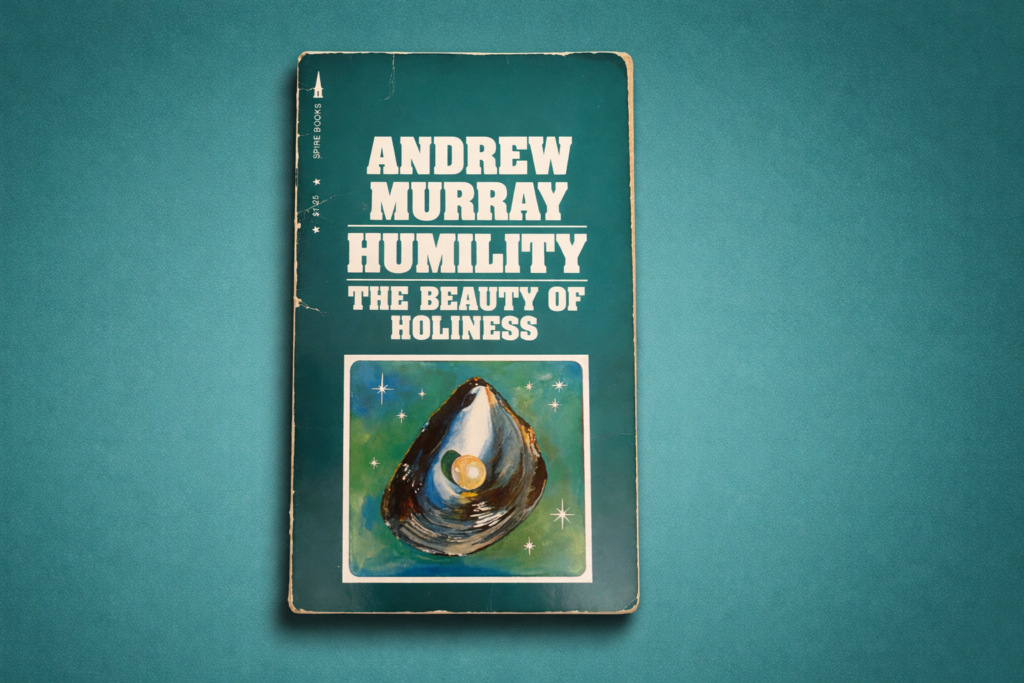
In In Humility: The Beauty of Holiness (Spire Books), Andrew Murray explores humility as a “place of entire dependence on God” (Murray, 12). Murray describes it as “the first duty and the highest virtue of the creature, and the root of every virtue” (Murray, 12). Though originally published in 1884, the theological paradigm feels even more urgent today. Murray offers a vision of humility that is counter-cultural to our world’s self-driven culture, and it’s often false humility. Rather, for Murray, humility is the expressed reality and fruit of the transformative grace of God and the Holy Spirit at work in us. True humility emerges when we come to the end of ourselves—when “we have seen ourselves to be nothing, have consented to part with and cast away self, to let God be all” (Murray, 33).
Information about humility and an understanding of what humility promises alone will not produce the powerful transformation true humility brings in us. Still, Murray gives us both a goal to pursue and a framework to inhabit. In his words, he offers a vision that understands “humility is nothing but the disappearance of self in the vision that God is all” (Murray, 44). Humility permits God to be who he is, for us to lose ourselves in comparison, and for us to accept that vision is all we need for every area and arena of our lives. Murray’s work is a map that shows the work of humility in the life and teachings of Christ, and how our faith, character, and right living must be defined by the same humility exemplified in our scriptures. This book truly gives us the beauty of holiness.
Humility by Andrew Murray
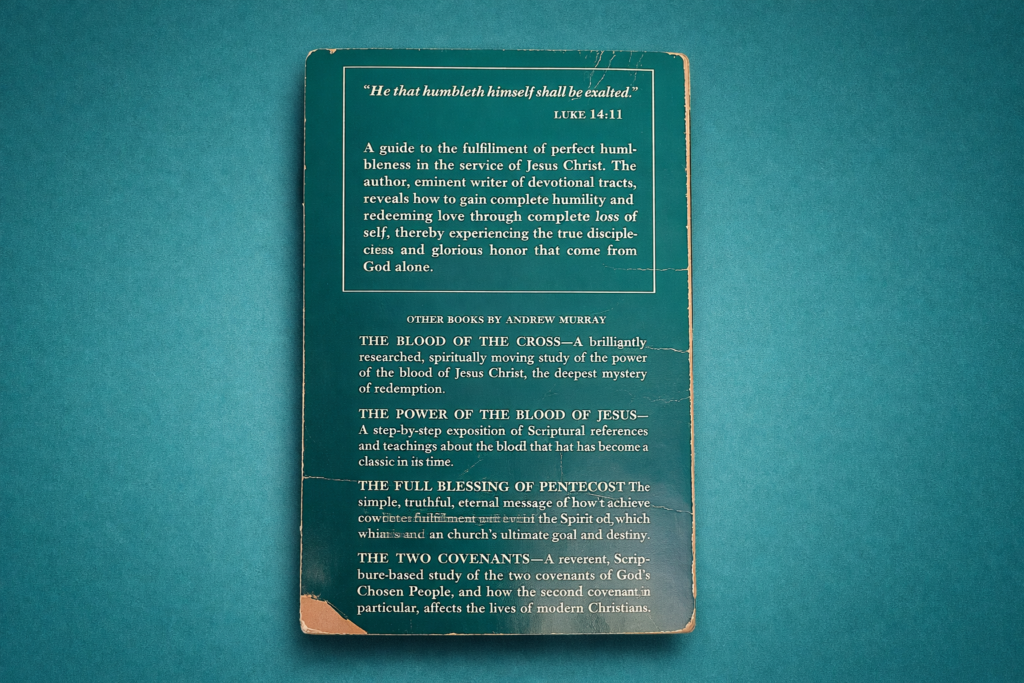
This short volume, released in mass paperback format by Spire Books (Fleming H. Revell Company), runs about 75 pages, with additional introductory and concluding reflections surrounding the twelve main chapters. The notes section includes further references and formative material, and Murray closes with a suggested prayer for those seeking to grow in humility. The twelve chapters are arranged in a way that builds on one another. Since this edition, which I couldn’t find a date on, an Amazon search reveals several other editions of the same material have been published by various independent and well-known publishers. Despite being only 75 pages, Andrew Murray explores the beauty of holiness in only the way he can, writing with poetic and theological rhythm.
Inside Humility: The Beauty of Holiness
In Chapter 1, Murray explores humility as the glory-state of created beings. In Chapter 2, he presents humility as the secret of redemption. In Chapter 3, he theologically unpacks how humility is present in and through the life of Jesus. Then, in Chapter 4, Murray explores humility in Jesus’s teaching.
The disciples’ humility is examined in Chapter 5. In Chapter 6, he considers humility in daily life, drawing especially from the Pauline epistles. Murray explores the connection between humility and holiness in Chapter 7. In Chapter 8, humility is presented as a way of breaking our connection to sin.
Chapters 9 and 10 explore humility in relation to faith and to the death of self. Chapter 11 considers how humility is connected to happiness. Finally, in Chapter 12, humility is linked to exaltation and the way God brings about the next stage of our formation.
A Few Notes from Humility
One of the more memorable images I took from Murray’s Humility: The Beauty of Holiness concerns his claim that humility is central to God’s narrative. Similar to Reeves’ Delighting in the Trinity, which presents love as the reason for creation, Murray offers humility as the vision, fuel, and narrative arc that give creation its purpose.
Creation, Murray maintains, is about making “the creature partaker of His perfection and blessedness” in order to show forth the glory of God’s “love and wisdom and power” (Murray, 11). This act of extending grace to humans is a work of humility. This act involved allowing humanity, with its limited capacity, to receive “as much of His own goodness and glory as they were capable of receiving” and to become humble ambassadors who bear witness to it within the created order (Murray, 11).
He unpacks the Genesis creation story to show that God’s act of enlisting us is one of humility. At the same time, Murray casts us into a life where we discover humility by living in the “place of entire dependence on God,” because this is the original nature of all things, the first duty, and “the highest virtue of the creature, and the root of every virtue” (Murray, 12).
From there, the steps we take away from humility and dependence on God lead to pride, which Murray describes as “the loss of this humility” and “the root of every sin and evil” (Murray, 12). I think Murray captures this beautifully. This is why we needed redemption.
So Jesus enters the scene to embody humility:
“And so Jesus came to bring Humility back to earth, to make us partakers of it, and by it to save us. In heaven He humbled Himself to become man. The humility we see in Him possessed Him in heaven it brought Him, He brought it, from there. He on earth “He humbled Himself, and became obedient unto death”; His humility gave His death its value, and so became our redemption” (Murray, 12).
Truly, Jesus walked in humility with the Father in the created world and humbly allowed himself to go even to the cross. This humility becomes part of our salvific story. Or as Murray states, “his humility is our salvation. His salvation is our humility,” this truth should drive us into unmatched and unrestricted humility (Murray, 12). Yet as he suggests, this journey is “too little regarded in the Church” because we don’t want to face the value of our “nothingness” (Murray, 13).
The Call to Battles
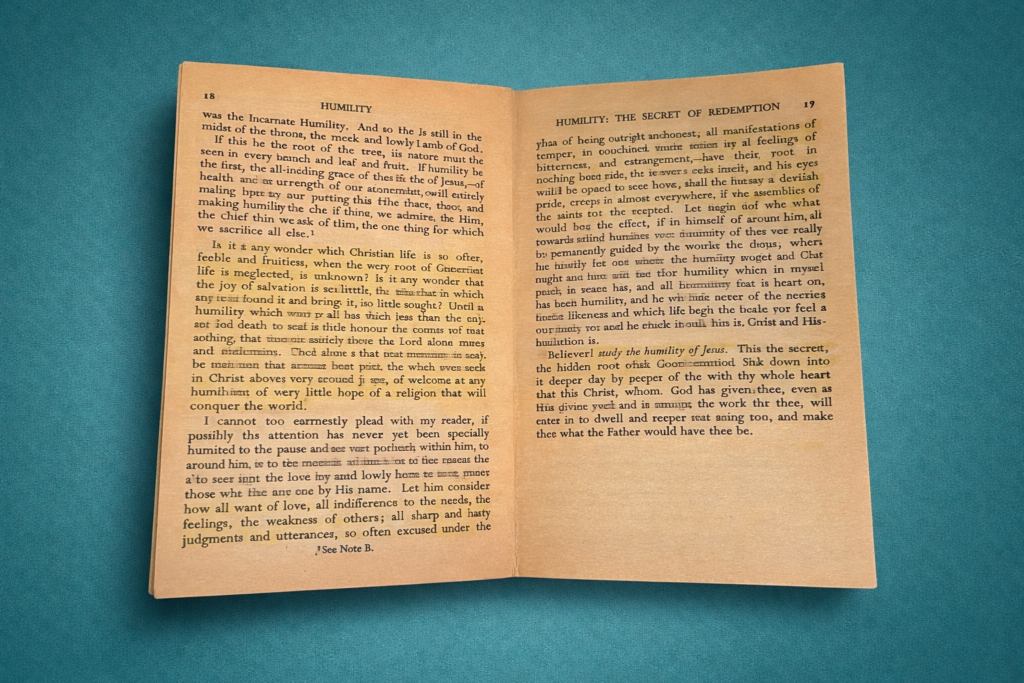
Chapter two reads like a call to battle, but one unlike the ways of the world, a battle with the pride in our lives and religious systems. Murray remarks, “All the wretchedness of which this world has been the scene, all its wars and bloodshed among the nations, all its selfishness and suffering, all its ambitions and jealousies, all its broken hearts and embittered lives, with all its daily unhappiness, have their origin in what this cursed, hellish pride, either our own, or that of others, has brought us. It is pride that made redemption needful; it is from our pride we need above everything to be redeemed” (Murray, 15-19). Our pride continues to be a spiritual wrecking ball in our lives. I love the way Murray unpacks this, stating, “Pride has its root and strength in a terrible spiritual power, outside of us as well as within us; as needful as it is that we confess and deplore it as our very own, is it to know it in its Satanic origin” (Murray, 15-19). Murray gives us the root of insecurity, inner turmoil, and our own ineffectiveness. He maintains that we are so “feeble and fruitless,” our “joy of salvation is so little felt” because this “root of the Christ life is negelcted” (Murray, 15-19). Unless the church rediscovers humility as Christ understood it, taught it, and modeled it, “there is very little hope” for our faith to live out it’s victorious state (Murray, 15-19).
We must find where pride is at work in our lives, undermining what God desires to do. That is the call to battle. Murray reminds us that”
“…all indifference to the needs, the feelings, the weakness of others’ all sharp and hasty judgements and utterances, so often excused under the plea of being outright and honest; all manifestations of temper and touchiness and irritation; all feelings of bitterness and estrangement, —have their root in nothing but pride…a devilish pride, [that] creeps in almost everywhere, the assemblies of the saints not excepted” (Murray, 15-19).
The invitation to victory is to “study the humility of Jesus,” to ask for the root of pride to be revealed, for redemption to come through the act of humility, a posture that needs to sink down deeper into us “day by day,” Murray reminds (Murray, 15-19).
Read Slowly
Despite its brevity, this is a book to read slowly. It invites meditation. It is the kind of work worth returning to every few years—a reminder of the theological depth, practical wisdom, and scriptural witness surrounding humility. We never outgrow the need to understand humility more fully, and few resources are as concise yet penetrating as this one.
This thorough look at humility throughout Scripture culminates in an invitation, again and again, to “hide ourselves in Him until we be clothed upon with His humility” (Murray, 46). To hide ourselves in Him until we experience His humility, we “must…die to self; so we prove how wholly we have given ourselves up to it and to God; so alone we are freed from fallen nature, and find the path that leads to life in God” (Murray, 56). This book offers a vision of a new life “of which humility is the breath and the joy” (Murray, 56). Murray’s holistic treatment of humility—and its prophetic invitation to a truer Christian walk throughout the New Testament—calls us to come to the end of ourselves.
Even in his time, I believe Andrew Murray knew he was writing a prophetic challenge to the church. Murray remarks:
“The call to humility has been too little regarded in the Church, because its true nature and importance have been too little apprehended. It is not something which we bring to God, or He bestows; it is simply the sense of entire nothingness, which comes when we see how truly God is all, and in which we make way for God to be all” (Murray, 13).
The life of humility is even less valued in the large boxes of splendor we have built and the empires we have renamed campuses and movements. Perhaps humility, as understood by Jesus, is no longer truly understood. It has become harder for us—both as individuals and as church communities—to face our own nothingness so that God might be experienced as all in our humble state. We have become too good at building great things to humble ourselves to experience a Great God.
About Andrew Murray
I first encountered Murray early in my spiritual search. He has been a favorite ever since. I have read many, and re-read many. Andrew Murray (1828–1917) was a church leader, evangelist, and missionary statesman who served for more than sixty years in the Dutch Reformed Church of South Africa. He wrote over 200 books and tracts on Christian spirituality and ministry. Some of his best-known works include The True Vine, Absolute Surrender, The School of Obedience, Waiting on God, With Christ in the School of Prayer, and The Prayer Life.
Humility in Jesus
Murray argues that some poignant statements in John’s Gospel reveal the deepest foundation of Christ’s life: a humble way of dependence on the Father. We get glimpses of this humility at work in the life of Jesus when he says things like: “The Son can do nothing of Himself” (John 5:19), “I am come not to do Mine own will” (John 6:38), and “I do nothing of Myself” (John 8:28). Murray points out this is not weakness but perfect humility that is to be modeled in our relationship with God the Father. Humility, the dependence on God, is how Christ’s power flows precisely from Jesus’ refusal to act independently. Jesus models a way of glory from our exaltation as an act of humility, not from others. When Jesus declares, “I receive not glory from men” (John 5:41) and “I seek not Mine own glory” (John 8:50), He does not seek recognition; He calls us, by example, to live entirely for the Father’s honor.
For Murray, these verses reveal (and many others he cites) the inner life of Jesus: absolute surrender, unbroken dependence, and a complete renunciation of self-initiative and self-glory. This, he argues, is true humility—not thinking less of oneself in a psychological sense, but living in total reliance upon God. Christ’s humility is the pattern and source of ours.
Murray also shows that throughout Jesus’ ministry, Jesus repeatedly taught and embodied humility as the essential posture of life in God’s kingdom. From the Beatitudes—where the poor in spirit and the meek are declared blessed—to Jesus’ invitation to “learn of Me, for I am meek and lowly of heart,” Jesus presents humility as the entrance, path, and character (way) of the kingdom. In response to the disciples’ ambition and desire for status, Jesus places a child in their midst, calls them to servanthood, warns against seeking honor as the Pharisees do, and teaches that those who exalt themselves will be humbled. Through parables, table conversations, and ultimately the washing of His disciples’ feet, Jesus makes clear that greatness in God’s kingdom is measured by lowliness and service. Again and again, Murray insists on a way of living, modeled on Jesus, in which humiliation is the only ladder to true honor. Murray laments that this teaching, though central to Christ’s message, is rarely preached, practiced, or even recognized as lacking among believers. I can’t imagine what he would think today.
A Convicting Read
In reading Murray, I realized this is the very journey I have been on since a verse from 1 Thessalonians 4:11–12 impressed itself upon me a few years ago. That key text, which I have often reflected on, has not only anchored my life and become a filter for my intentions and steps, but it has also formed in me a call towards greater humility in my heart.
The heart is a restless, complicated place, and I know I need a greater and deeper humility that truly defines my life. As I read this book, I sensed that such humility would lead to greater fruitfulness and deeper faith in my life with Jesus. This is what Murray is after in his book: a more fruitful Christian life, of which humility is at the core.
I believe Murray is right: “How little this is preached. How little it is practised. How little the lack of it is felt or confessed” (Murray, 26). Let’s change that. More than ever, this message of humility, this call to live a life of complete dependence and surrender, is needed.