
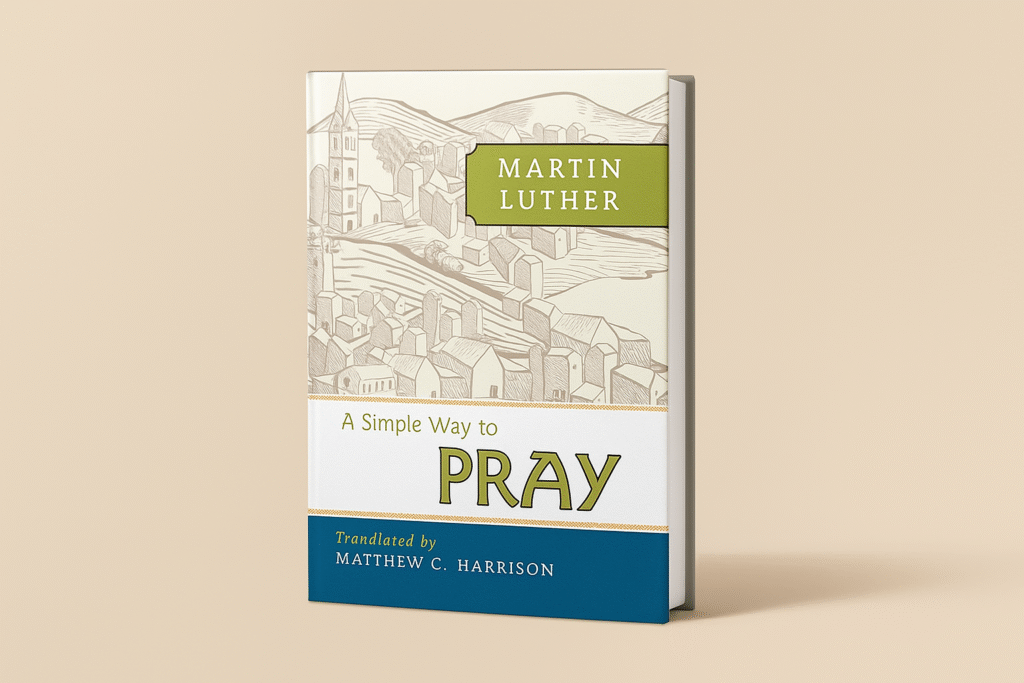
“To this day, I nurse on the Lord’s Prayer like a little child, and like an old man now, I eat and drink from it, but never get my fill,” writes Martin Luther to his barber, Master Peter, in his 1535 letter A Simple Way to Pray. Luther’s honesty is refreshing. He admits it is easy to become “cold and apathetic about prayer,” often because of “all the things that are distracting me and filling my mind.” This honesty is a breath of fresh air in a world of TED talk sermons; it is an essential reminder that the Lord’s Prayer becomes a life-sustaining source of faith in our lives.
I would assume that many of us can relate to Luther’s confession. Seemingly, it is this same reality that he is helping his barber address in his own prayer life. To “nurse” on the Lord’s Prayer, as Luther puts it, is to meditate deeply on its words. “A true prayer,” he confesses, “meditates on all the words and thoughts of the prayer, from beginning to end.” Each petition matters. The order matters. There is something powerful about that practice. For Luther, the Lord’s Prayer should be prayed “completely, word for word,” dwelling on each petition to reflect on its realities in the external world. Nothing about it should be taken for granted, ignored, or replaced.
Yet, in saying this, I find it shocking that Luther’s reflections reveal a missing dimension—internal reflection and personal formation. One cannot help but notice that in his efforts to provide commentary on each petition to Master Peter, the commentary frequently turns the prayer outward as a weapon against others rather than a mirror for self-examination. This appears to be in radical conflict with the context of Jesus’ teaching on prayer in Matthew and Luke.
We need more confession, more community, that which the Lord’s Prayer calls us to —more focus on where we are not living it, rather than on those who are not living it.
The Problem of Projection in A Simple Way to Pray
Luther’s commentary on the Lord’s Prayer often uses the Lord’s Prayer to condemn what he perceives as external evils. In the first petition—“Hallowed be Thy Name”—he prays against “the heresy of the Turks, the pope, and all false teachers and sectarian spirits,” while failing to recognize how his own behavior might fall under that same critique.
Similarly, in “Thy Kingdom Come,” he prays against “big, fat, and full people who plague, hinder, and interfere with Your Kingdom’s humble flock,” identifying as that humble flock himself rather than considering that he, too, might be among those hindering the kingdom. If you need help to see where he hindered the kingdom, read the shame found in the Bondage of the Will or the issues he had with the Anabaptists.
In the third petition, “Thy will be done,” Luther prays against those who desire to harm but misses the deeper call to obedience within his own life. Most concerning is his handling of “Give us this day our daily bread.” Rather than recognizing this as a prayer of dependence upon God’s sustaining grace, Luther turns it into a prayer for good governance: “Give all kings, princes, and lords good counsel and the will to maintain their lands and people in peace and with just laws.”
Only in the petition on forgiveness does Luther move slightly inward, calling for “boundless mercy” on those who need forgiveness. And in “Lead us not into temptation,” he offers a helpful word for today’s American church: a prayer that we remain “alert, passionate, and diligent in Your Word and service, so that we do not become secure, lazy, and sluggish.”
Still, his version of “Deliver us from evil” fails to recognize how the Spirit delivers us not only in the life to come but also in this present world.
A Prayer Turned Weapon
Luther—so often brilliant, yet tormented by his own guilt and shame—unconsciously turns what could have been a prayer of confession and spiritual reconstruction into a weapon aimed at others, and external evils, without addressing the shadows of evil within. The Lord’s Prayer, which could serve as a pathway of confession and a framework for rebuilding both our lives and our theology, becomes, in his hands, a tool for judgment.
And yet, amidst the contradictions, Luther reminds us of the prayer’s sustaining power in needed and essential ways. This is a prayer that deserves its adequate time and space. Luther laments that many have prayed it “a thousand times a year” and still “not have tasted or prayed even one letter of it.” That insight alone is worth sitting with (though not in the same way he means it as a jab towards those of the Catholic faith).
The Four Golden Threads in A Simple Way to Pray
After addressing the Lord’s Prayer, Luther shifts his focus to the Ten Commandments and the Apostles’ Creed. Ironically, the man who rebelled against formulaic religion offers one of his own (Lord’s Prayer, Commandments+ the Apostles Creed=A Simple Way to Pray?). It is obvious, based on the amount of commentary and through his own words, that the Commandments, not the Lord’s Prayer, become for him the “meat,” and I grieve to see the Lord’s Prayer reduced to foreplay.
Yet within this section, Luther introduces something worth recovering (or rediscovering): what have become known as his four golden threads—a framework for reading and praying Scripture that anticipates practices like lectio divina. The four threads are Instruction, Thanksgiving, Confession, and Prayer—or, as I summarize them, I.T.C.P. (Not to be confused with I.C.P.—the Insane Clown Posse!).
- Instruction: Read the commandment and consider what it teaches.
- Thanksgiving: Thank God for something related to the commandment.
- Confession: Acknowledge sin and ask what this commandment calls you to repent of.
- Respond to God in conversation and petition.
In dealing with prayer and meditation on the commandments, Martin Luther models genuine inner reflection—something he lacks in his treatment of the Lord’s Prayer. He even admits that through this process, he realized his “innumerable idolatries.” Failure in prayer could also be defined as allowing the law to drive you to confession, but not the things close to God’s heart (which are equally important). As is often the case, in narcissistic fashion, Luther is characteristically self-assured, as he shares that he recognizes how confession exposes his failures even amid his “high gift and beautiful teaching.” This narcissistic virus is perhaps why elitism has remained in many of the reformed era churches since.
Faith, Amen, and Anfechtung
Luther includes in his letter a reminder to Master Peter that good prayer ends with a strong Amen—one full of conviction, faith, and confidence that “God certainly does hear you and says ‘yes’ to your prayer.” The Lord’s Prayer, when prayed as a pathway of confession and a framework to rebuild our lives around, is undoubtedly the kind of prayer that God answers.
Matthew C. Harrison’s translation, with its helpful preface, highlights how these four threads of instruction, thanksgiving, confession, and prayer, can guide believers through what Luther called Anfechtung—the inner and outer spiritual assaults that threaten our faith. The translator notes that such a process “requires a time of solitude and intentionality.” I agree.
I find resonance in that. I use similar reflective practices in reading the scriptures at Water Street Mission chapels and during Fifth Sundays at River Corner Church. They help us experience God’s presence in the midst of struggle. I may even explore how to incorporate more of Luther’s four threads into my practices in a more comprehensive way.
There is one conflict for me worthy of note in Harrison’s preface, which encourages us to use the four threads as a way of prayer. He states that thanksgiving should be used as a prayer space, especially for pastors and mentors—those who have taught and shaped us in faith. That’s an important reminder, though I’d expand the view of gratitude beyond ministry leaders. We should pray for others, for those who have formed us, but we do not need the “Great man of God” syndrome further perpetrated. There are many more things that should inspire us to feel gratitude in life. Every moment presents an opportunity to cultivate greater gratitude. Scripture teaches that “everything created by God is good, and nothing is to be rejected if it is received with thanksgiving” (1 Timothy 4:4–5). Every aspect of life can and should become a prayer of gratitude, which will sustain us in greater ways.
Conclusion: Threads Worth Keeping
Matthew C. Harrison gives us a valuable translation of A Simple Way to Pray, a letter that reveals both Luther’s brilliance and his blind spots. We are reminded that the Lord’s Prayer—if prayed with depth and humility—becomes a tether to Jesus’ ways, words, and works. It keeps us rightly within Jesus’ calling, church, confession, and causes. Luther gets the value of the Lord’s Prayer, and misses the path of confession and rebuilding framework it is.
While Luther failed to apply his own four golden threads to the Lord’s Prayer (only the commandments and creeds), doing so today could transform how we pray and live. Luther’s words, for all their flaws, invite us to slow down, meditate, and rediscover a simple way to pray—anchored not in judgment, but in Jesus. The beauty we must discover if each line of the Lord’s Prayer is prayed slowly, as a slow cooker, reminding us what it is teaching us, what gratitude we have to face in our lives, where it is calling us to confession, and how we can pray