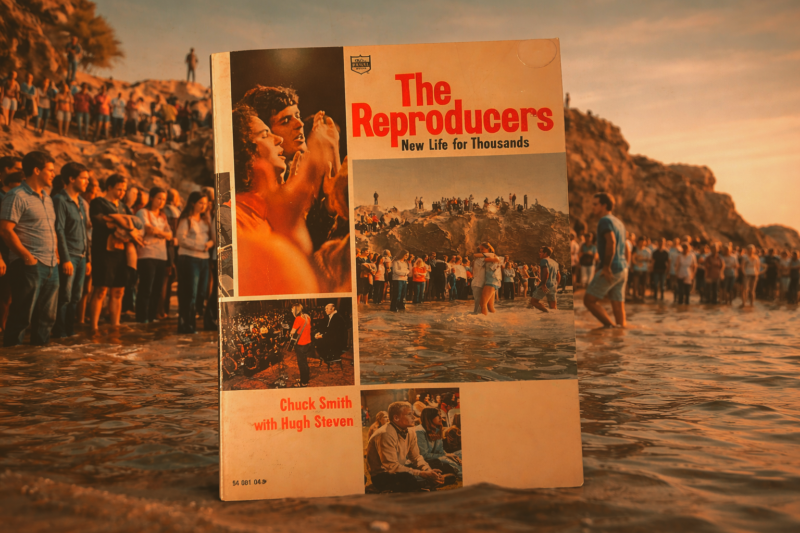
There are many expressions of the Christian church that have been calling, preparing, and praying for renewal, revival, and revitalization for years. Meanwhile, many of these expressions and movements are also being deconstructed as recent failures and exposures within many charismatic and Pentecostal movements have many individuals questioning whether what was promised as signs and whispers of renewal, revival, and revitalization was sincere and authentic. Though Christianity experienced remarkable and memorable renewal and revival in the early 1900s through the Azusa Street Revivals and in the 1960s through the Jesus Revolutions, there is a significant difference between what churches want to see now and what we saw then. In Azusa Street Revival, by Clara Davis, an eyewitness of the Azusa Street Revival, we are reminded that authentic “revival causes people to come face to face with themselves and with God.” Among the Pentecostal and Charismatic circuits, we are sold on signs and wonders that lead to authority and platforms, but we are not seeing people coming face-to-face with themselves and with God.
Flesh, Spirit, and the Trap of Personality
The recent tragic revelations surrounding leaders like Mike Bickle at IHOPKC illustrate the danger of a ‘revival’ culture that prioritizes preserving a movement’s reputation over the repentance of its leaders. While Azusa Street was often messy and unpolished, its fruit was humility that led people to their knees; in contrast, modern iterations often feel like carefully curated brands in which the “sign” is the leader’s personality rather than the surrender of followers of Jesus who are hungry for the things of God.
Truly renewal and revival, like we saw in the 1900s and 1960s, lead to great confession and surrender. This line, reminding us that revival causes people to come to an end with themselves, was one of the biggest takeaways from my recent read of Azusa Street Revival by Clara Davis, released in 1993 by Whitaker House (Pittsburgh, PA).
Though intriguing, this short book (printed in 12-point font and just over 140 pages) reads more like a collection of short blog posts in today’s post-modern, technological world than a book. That does not mean it lacks encouragement, challenge, or meaningful information. Rather, I just want readers to understand that at times this book feels more like a journal entry, mixing memories and meditative reflection on a personal journey, more akin to a blog post than a book that necessarily required paper and ink. It was not uncommon in this era for mass produced paperbooks to rush stories and authors to print. Though in most of these style paperbacks, there is still meat to chew on, despite the bones to spit out.
I was not familiar with Clara Davis before reading this work, though I have learned since that she and her family have produced other books. The Azusa Street Revival has long interested me for various reasons, and over the years, I have read several eyewitness accounts, criticisms, and testimonies related to it. Because of my interest and background, I came into this book with certain expectations for details and complex stories. I will admit that I was hoping for more detail and narrative than Davis ultimately provides. Despite that, I was intrigued by much of the story and the prophetic challenge to see what was deposited in her generation to be stewarded into each generation that follows in a contextualized way.
Davis’ upbringing in West Texas, with a father who was a cowhand, and in a time of great poverty and obstacles, led him to move them to California in 1895. Settling into Downey, an old west neighborhood compared to what it is today, her family encounters challenges to their Methodist faith as they encounter the Holiness and Pentecostal movements. As her father forms a friendship with and an appreciation for Brother Seymour, their family grows in faith in a deeply convicted way. The countless stories of renewed, passionate, and emboldened evangelical faith that many develop in light of the Azusa Street story are among the greatest evidence and witnesses to what God did through this chapter of the story.
Witnessing the Spontaneous and Unscripted
Davis’s life is closely tied to the story she tells. Davis retells some of the wonders and miraculous stories she remembers, the tensions that formed with other church movements, the fruit of what God was doing at the time, and the way her own family was drawn in. She reminds us that the acts of God in these situations erase barriers and boundaries. A memorable line within this regard from Davis was, “when a Holy Ghost revival hits a city, God’s Spirit causes the high places and low places to flow together.” This was evident in the Azusa Street Revival and those it inspired. Many have reported that into this community and its expressions, we find white, black, poor, rich, urban, and rural all coming together. I also loved her description of the early days of this movement, she says:
“People were hungry for God. Special prayer meetings were going on everywhere. God had put a new hope in people’s hearts. They would meet early in the morning and start singing. They had no songbook and no piano, but, oh, what singing! One of their main songs was “The Comforter Has Come.”
“They would sing for a while, and then those who had been filled with the Holy Ghost would get up and tell about it and how wonderful it was. After some testimonies, someone would preach and tell what God had promised. Then it would start all over again, going on almost all night. If anyone was hungry, they would leave for something to eat and then return as soon as possible.”
If you know the story, this led to many people from across the United States and ultimately the globe taking an interest in what seemed to be happening in Azusa Street. Davis recalls:
“Missionaries soon came from all over the world to witness this new outpouring of the Holy Spirit. They began to take news of it back to their fields of labor and to share this message with others. Revival seemed to break out spontaneously all over the world.”
In comparison to today, where many Pentecostals and Charismatics keep the supposed work of God in their locale as a platform building, a consumeristic experience to be drawn to, Azusa Street went viral, and contagiously so. It was the love of God making itself known to a generation; it was not a story like those today, those about what God was doing in a church community, neighborhood, or personality.
We truly need such a hunger again, a hunger for the things of God that draw us into worship, the scriptures, prayer, and the stories of God at work. To inspire that hunger again seems to be at the heart of Davis’ reason for writing this book. She shares that every generation needs to find its way, its hunger, and its experiences. Davis states that “we cannot live in the past. It is time to move on! Our young people would like to know what is for today.” She shares her own responsibility to carry this legacy on in this way: “This is a great heritage, and it must be carried on. Each generation is responsible for the generation in which they live.” As someone who spent some years within the Vineyard Movement and has spent the last sixteen years or so within Anabaptist churches, I realize there is much I have experienced that I desire my children to experience as well.
Davis certainly tried to live up to that call to pass faith on. Ordained alongside her husband, R. L. Davis, the two pastored and evangelized across the United States for many years. Together they raised three sons, all of whom became involved in ministry. Davis grew up in a Methodist home, but her family moved to California at a pivotal moment when the passionate encounters at Azusa Street began to challenge and reshape their understanding of faith. Her parents experienced what they understood to be a fresh work of the Spirit and a renewed sense of calling, becoming participants in a movement that would soon spread far beyond Los Angeles. Davis includes her mother’s and one of her sons’ testimonies in this book.
After her husband’s death in 1972, Davis remained active in Christian ministry, including involvement with Women’s Aglow, and continued to share stories and memories from the early days of the Pentecostal revival and the ways she believed God’s power had been poured out in the early twentieth century.
The Necessity of Spiritual Balance
Davis also desires a Spirit-led movement of purity, integrity, accountability, and authenticity. She writes about what is needed:
“…spirituality without discipline becomes hypocrisy. Prayer without repentance, humility, and faith is anemic and hopeless. Worship without obedience and involvement in God’s work is like smoke in God’s nostrils. Spiritual gifts without spiritual fruit are weak and ineffective. There must be a balance.”
Regardless of where we fall on the cessationist-continuist scale, I believe that statement should challenge us.
This lack of balance is precisely what critics like Mike Winger have highlighted in his deep-dives into the Bethel movement. When the pursuit of the “supernatural” becomes disconnected from the authenticity and obedient scriptural discipleship Davis is calling for, the result is too often a theological drift in which experience trumps truth. Through her stories, Davis insists that spirituality without discipline is hypocrisy.
Unlike many movements and church leaders today, Davis does not hide from the human factor in these elements. She mentions that this movement would be among “the first to admit that there have been mistakes and excesses.” She continues with this honest and transparent line, “All who claimed did not possess still had much to overcome, both in lack of wisdom and carnality. It is always easy in times like this for the enemy to take advantage of people’s enthusiasm and inexperience by bringing in false doctrine, even as in Paul’s day when errors and misconceptions had to be combated.” The story we write together from here on out, a truer story, is what matters. Davis reminds the church today, “It is what we have today that counts. There must be a daily renewing. The danger is that we will throw up walls around our own groups so high that hungry hearts who may be looking our way cannot feel free to come in and out and find pasture. Spiritual pride and prejudice hinder the free moving of the Holy Spirit.”
This admission into the ugly belly of such moments in history stands in stark contrast to the movements and failures practicing DARVO techniques to hide their own wrongs.
I do not care which movement of churches we belong to; this warning about isolation and spiritual pride stands, because “another danger for nondenominationals is developing a pride of independence. We are all the body of Christ and need one another. May God give us balance that we might be able to recognize the move of God wherever it is flowing.” The church must become a collaborative, loving, and confessional community. We have to face that “God’s harvest has been bruised and hurt by many well-meaning people who have not shown a spirit of love and forgiveness, but who have been quick to judge and criticize the little lambs for whom Christ died.”
- Revival causes us to come face-to-face with God and ourselves.
- Revival causes confession and surrender.
- Revival doesn’t stay in a place; it contagiously spreads to other people and places.
- Revival causes us to admit that evil and the evil one still exploit these movements in some way.
From Platform to Discipleship
I found something else important in Davis’ writing. When movements like this take place, and evangelism, missional impulses, and energetic missionaries go out, they do not go out with platform and dominionism. She shared that as schools, orphanages, and evangelistic centers were formed around the world from what God was doing at Azusa Street, they focused on doing something unusual for this time; they focused on training foreign nationals “to be leaders and pastors of their own people. It is the aim of these churches to make foreign missions work indigenous.” She continues, “Should a nation ever close its doors to American missionaries, these nationals will be able to carry on the work on their own without having to depend upon outsiders.” This isn’t a speak circuit, or a large-scale festival, or a televised healing service. It is discipleship. Revival causes discipleship to contextualize itself in real places, real people, and in real ways. They do not conquer for the Kingdom or perform for the praise, but release what God is doing in the lives of others in ways they can own for themselves.
A Recommendation for Azusa Street Revival
This is a short book that takes just an hour or so to read. It is mostly personal reflection and calling. It is a sense of what she feels God wants to deposit in the next generation. If you want to hear that kind of reflection, and can take the lack of depth into consideration, you will find things that challenge you in today’s world, longing for revival, legacy, and to pass faith on.
Another reviewer on Amazon found the book unhelpful because it lacked the expected historical depth and narrative it promised, instead offering what they believed were “patronising” instructions and a poor writing style. They ultimately felt the work functioned more as a repetitive collection of personal encouragements than a meaningful historical testimony. I did not get the patronising sense, but the rest is a fair critique.
You can also read my highlights and quotes from Clara Davis’s Azusa Street Revival and buy the book on Amazon.