
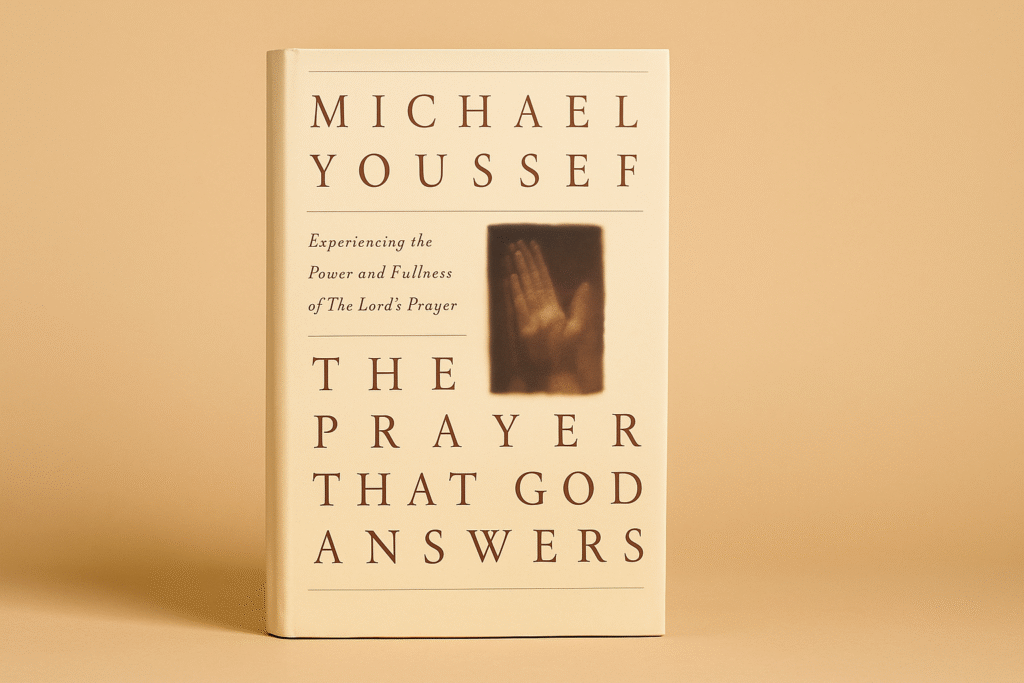
In prayer, we are not seeking to inform God of our condition or persuade God of our position. Prayer is not an act of manipulation or flattery; it is an act of surrender. In The Prayer That God Answers, Dr. Michael Youssef reminds readers that, regardless of our condition, position, or context, “prayer is about surrender to God’s purposes” (Youssef 2000, 5). The Lord’s Prayer is not merely a model of how to pray—it is a framework that teaches us what to pray. As Youssef writes, it helps us “pray for the right thing—because that is God’s central purpose in having us pray” (Youssef 2000, 10). This book was released in 2000 by Thomas Nelson Publishers.
The Prayer That God Answers
Effective prayer requires intentionality and focus. For this reason, Youssef encourages giving it “adequate time,” “adequate space,” and “adequate attention” (Youssef 2000, 11–12). Though, he doesn’t define clearly what effective prayer is. Perhaps one of the greatest injustices we do to the Lord’s Prayer is assuming we understand it simply because we have it memorized (Youssef 2000, 8). This book aims to guide readers toward a deeper understanding of the prayer Jesus taught, helping them experience the kind of prayer that God answers.
Why I Read The Prayer That God Answers
I chose this book as part of the 10,000 pages I committed to reading for my Doctor of Ministry studies at Kairos University, where I am exploring the Lord’s Prayer as a spiritual formation tool—a pathway of confession and a framework for theological realignment. It serves as an anchor in a consuming, chaotic, and identity-confused world. While Youssef offers a practical, sermon-like reflection on each petition, he often overlooks the prayer’s historical, scriptural, and theological dimensions. Each petition becomes more of a launching pad for pastoral reflections than a contextual study of the text. Of the 10,000 pages I’ve read so far, though I enjoyed this one, it offered the least depth in terms of historical, cultural, and theological engagement.
An Inside Look
The book reads like a study guide. Each petition (which feels like a megachurch sermon from story to points) is accompanied by a brief, practical commentary, followed by workbook-style activities. Readers are invited to reflect on Scripture, journal, and pray through each section. Churches and families studying together may find this format especially practical and engaging. Youssef writes like a pastor—accessible, passionate, and useful. While some of the illustrations are deeply meaningful, others at times distract from the depth and mystery of the prayer itself.
Some Significant Drawbacks
A few areas where Michael Youssef seems to miss the mark stand out. When addressing the reminder that God is in heaven, Youssef focuses primarily on the eternal dimension but overlooks the opportunity to explore the broader meaning of “heavens” and what God is doing here and now. Indeed, “the glimpses and foretastes of heaven supplied to us in the Bible should whet our appetites and make us long” for that reality (Youssef 2000, 43). I didn’t take any challenges away from Chapter 6 on God’s Will, which missed some good opportunities. The comparison to Youssef’s own citizenship journey in the United States felt less than helpful as a picture of Kingdom citizenship. Still, his reminder that the Kingdom calls followers of Jesus to “publicly renounce…allegiance to any other spiritual authority” is both bold and timely (Youssef 2000, 81).
Youssef might also have spent more time unpacking the tension between the translations “deliver us from evil” and “deliver us from the evil one.” At times, he makes statements such as “this translation version is more accurate,” seemingly because it supports a sermon point rather than out of a defined textual or theological rationale (see discussion on p. 174). Overall, The Prayer That God Answers is a good and engaging book, though at times it feels oversimplified. Given its intended audience, accessibility is understandable and even beneficial.
Some Positives of The Prayer That God Answers
There are several places where Youssef’s book proves especially helpful. The Lord’s Prayer is not to be treated lightly; it requires adequate time, space, and attention (Youssef 2000, 11–12). To understand God as Father means to sense and experience the gift of freedom from fear, along with confidence, compassion, and provision—and to extend those same qualities to one’s own children (Youssef 2000, 29–30). I appreciated Youssef’s treatment of “Hallowed be Your name,” as many readers associate that phrase with negative or outdated images:
“In popular modern culture the phrase ‘Hallowed be Your name’ conjures two images. First, a prohibition on swearing. And second, going to a cold church every Sunday morning and singing very dull hymns… ‘Hallowed be your name’ solemnly reminds believers of their responsibility to behave in a way that honors, respects, and brings glory to God. Every day we should seek to enhance God’s reputation through the way we live” (Youssef 2000, 62).
Youssef continues,
“Here is the key to hallowing God’s name—the top three attitudes we can cultivate that will magnify and glorify God. Be grateful. We use our hearts and lips to tell God how thankful we are… Be a giver. We give of our substance to God… Be obedient. We live in obedience to God and God’s Word” (Youssef 2000, 64).
The Kingdom, more than an eschatological truth (which Youssef tends to undervalue), is about living under divine reign in the present:
“Unpack those three little words—‘Your kingdom come’—and you will find what you’re really saying is this: King Jesus, rule supreme in my life. King Jesus, dominate my thoughts. King Jesus, reign over every member of my body. King Jesus, exercise full sovereignty over me. King Jesus, let Your program be my preoccupation in life” (Youssef 2000, 84–85).
I also appreciated the way Youssef challenges Western cultural assumptions about dependence and provision:
“In the West we have so much bread we end up throwing it in the garbage. We do not ask God to give us bread—all we have to do is go to the grocery store and buy it… But, of course, ‘daily bread’ here stands for much more than food. We are praying for God to give us what we need—and that means not just food, but warmth, shelter, income, companionship, and everything else up to peace and personal fulfillment” (Youssef 2000, 119).
Final Thoughts
In the end, The Prayer That God Answers succeeds as a devotional and pastoral resource that calls readers to deeper intentionality in prayer. It invites engagement with the Lord’s Prayer not as a ritual of repetition but as a rhythm for transformation. While the work occasionally sacrifices theological nuance for accessibility, it offers valuable insights for those seeking to deepen their practice of prayer and submission to divine purposes. I doubt this will be utilized in my doctoral project, but you can learn more here. Still, for readers new to the Lord’s Prayer or for church groups seeking practical application, this book provides meaningful material for conversation. For those desiring a more robust exploration of the prayer’s historical, linguistic, and theological framework, additional study will be necessary. Still, Youssef’s central reminder—that prayer begins and ends with surrender to God’s will—remains a timeless and much-needed truth.