
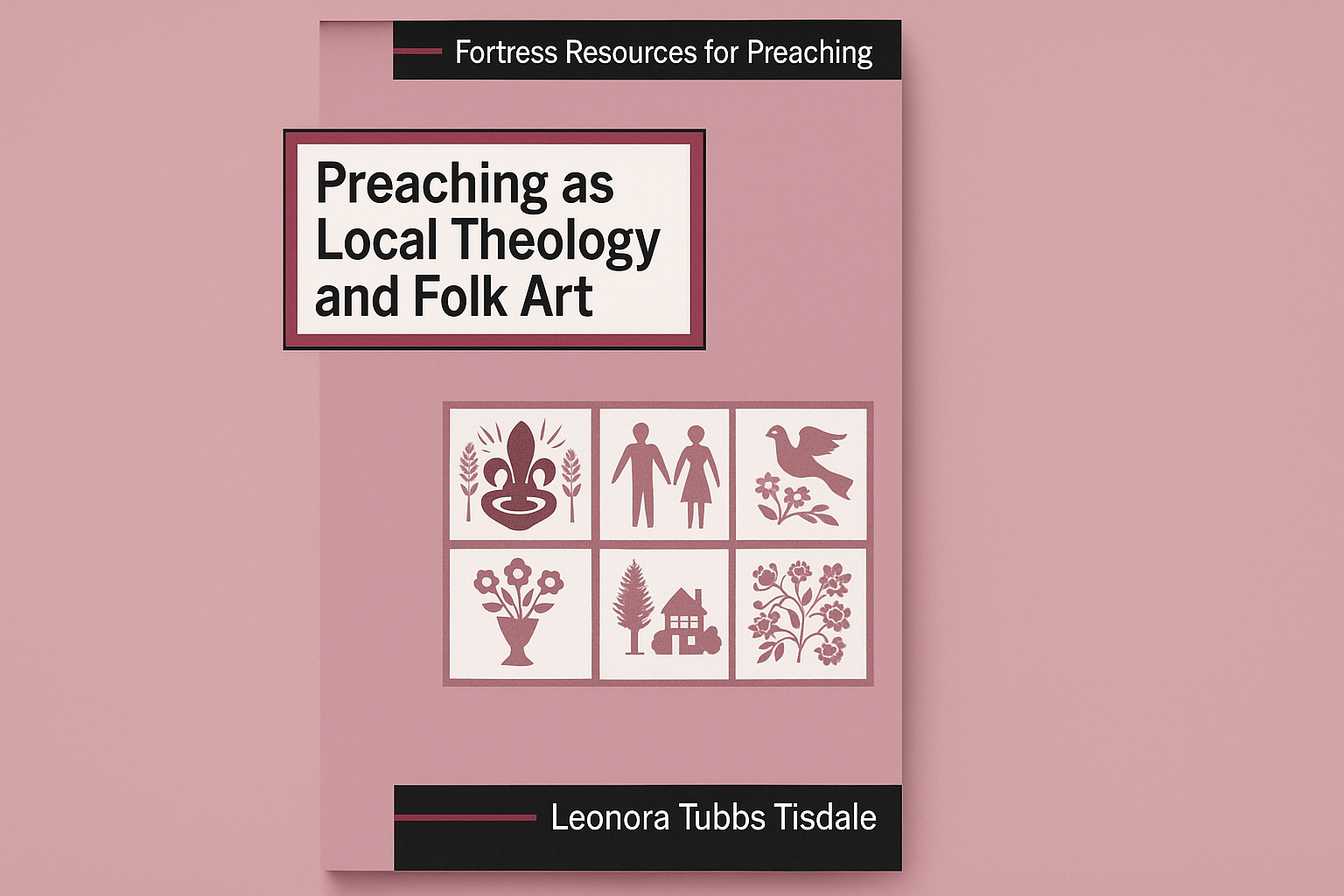
Released in 1997 by Fortress Press (Minneapolis, MN), Leonora Tubbs Tisdale—a former assistant professor of preaching and worship at Princeton Theological Seminary—reflects on her journey in leadership with a church where she discovered the tension between her own story and that of the congregation she was serving. These experiences taught her the importance of contextualizing pastoral leadership, particularly in preaching. From this realization emerged Preaching as Local Theology and Folk Art, a resource that encourages pastors to exegete their congregations as carefully as they exegete the Bible.
Preaching Beyond Theological Construction
Preaching well, according to Tisdale, is not only about being faithful to theological construction—it is also about preaching that embodies the ethos of a congregation. “The wise pastor will attend not only to the subculture of the congregation as a whole, but also to the diverse (and sometimes competing) subcultures that coexist within a congregation” (Tisdale 1997, 17).
Pastors, she argues, need explicit training in exegeting congregations—studying the unique cultures, values, and stories of their people—just as much as they need training in exegeting Scripture (Tisdale 1997, 18).
The Pitfalls of Preaching Without Context
Tisdale highlights three common mistakes that result from preaching without careful congregational exegesis:
- Delivering generic sermons for “generic humanity” that never connect with the specific lives of a congregation.
- Creating oversimplified or inaccurate portraits of the congregation.
- Projecting personal issues of the preacher onto the congregation (Tisdale 1997, 23).
As she observes, many sermons fail not because they are poorly constructed theologically, but because they lack contextual embodiment (Tisdale 1997, 32).
Preaching as Local Theology and Folk Art: Learning to Exegete Congregations
One of the book’s strongest contributions is its framework for understanding congregational identity. Tisdale encourages pastors to identify and interpret the symbolic “texts” that hold meaning for a community. These symbols may be verbal, nonverbal, ritual, visual, auditory, or even contradictory (Tisdale 1997, 62–64).
By engaging these cultural texts, preachers can discern the deeper narratives shaping their congregation’s identity and then craft sermons that faithfully embody the gospel within that context.
Preaching as Visionary and Imaginative Work
Contextual preaching, according to Tisdale, is not only descriptive but also visionary. It must interpret “the paradigmatic vision of God, humanity, and the world given in Scripture” in ways that remain faithful to the biblical witness while also “capturing and transforming the imaginations of a particular congregation” (Tisdale 1997, 94).
This task cannot be carried out by the preacher alone. Sermons must be shaped in dialogue with the lived experiences and perspectives of the congregation itself (Tisdale 1997, 96).
Preaching as Art
Tisdale ultimately concludes: “At its best, Christian preaching is not only an act of theological construction; it is also a work of art” (Tisdale 1997, 122). Sermons, like art, must tell stories, stir imagination, and invite hearers into a world where God’s truth is embodied. She asks in this section a question I will continue to wrestle with after reading this book, “When sermons seem to be ‘missing’ local congregations, the preacher as folk artist needs to ask, Could form be a part of the problem?” (Tisdale 1997, 139).
A Timely Yet Dated Resource
Though published in the late 1990s and showing its age in certain examples and paradigms, the book’s message remains deeply relevant. Some practical details may feel overstated, but the call to preach contextually is timeless.
Five Functions of Contextual Preaching
The challenge is that good contextualized preaching serves five significant functions. In this chapter, Tisdale identifies five ways contextual preaching can shape congregational life (Tisdale 1997, 111–114):
First, “Preaching can affirm and confirm the right imaginings of the congregational heart” (Tisdale 1997, 111). In other words, it celebrates the ways a congregation is already living in alignment with the gospel.
Second, “Preaching can stretch the limits of the congregational imagination” (Tisdale 1997, 112). By expanding narrow or limited understandings of God, church, and the world, preaching helps people see beyond their current perspectives.
Third, “Preaching can invert the assumed ordering of the imagined world of the congregation” (Tisdale 1997, 112). Much like Jesus’ parables, preaching can upend expectations—where the last become first, the Samaritan is the hero, and treasure-hoarding is called foolish.
Fourth, “Preaching can challenge and judge the false imaginings of the congregational heart” (Tisdale 1997, 113). This means naming idolatry and falsehood both within the church and in the wider world.
Finally, “Preaching can help congregations imagine worlds they have not yet seen (or even imagined)” (Tisdale 1997, 114). In doing so, it keeps believers grounded in the “already” of Christ’s work while inviting them into the “not yet” of God’s coming kingdom.
My Context and Recommendation
I read this book as part of my Doctor of Ministry studies at Kairos University, where my research focuses on the Lord’s Prayer as a framework for spiritual formation and communal discipleship. It was assigned in a course on Sociological and Cultural Foundations for Ministry, which challenged me to ensure my doctoral project is embodied within the communities I serve.
While I differ from Tisdale on some paradigms of church and ministry, I found her work to be a powerful reminder: preaching is not only about proclaiming Scripture, but also about embodying it within a particular community.
Final Word on Preaching as Local Theology and Folk Art
Though dated in parts, Preaching as Local Theology and Folk Art remains an excellent resource. Tisdale’s reminder is clear: preaching is proclamation, art, contextual engagement, and a shared act of imagination between pastor and congregation.